




Client-team collaboration breaks down in predictable ways: miscommunication about what was agreed, feedback that arrives in the wrong place or too late to action, revision requests that contradict earlier approvals, and version confusion that sends the production team working on the wrong cut. Each of these problems has a structural fix that doesn’t require better tools — just better process, consistently applied.
This guide covers the most common client collaboration challenges creative teams face and the specific workflow adjustments that resolve each one.
Challenge 1: Miscommunication at the brief stage
Most client-team miscommunication in creative production doesn’t happen during review — it happens at the brief stage, before a single frame is captured or designed. The brief defines what’s being made, who it’s for, and what success looks like. An ambiguous brief produces work that misses the target, and the client’s feedback is the first indication that something went wrong.
The root cause is usually that the brief exists as a document that both parties sign but interpret differently. Text-based briefs are inherently ambiguous about visual direction — “contemporary, minimalist, high energy” means something different to a creative director than to a client who’s imagining their competitor’s aesthetic.
The fix: Replace or supplement text briefs with visual references approved before production begins. A mood board that shows three directions — “this, or something closer to this, or this” — produces faster alignment than three paragraphs of adjectives.
For video and motion content, using an AI storyboard maker to rough out the visual sequence before production starts provides a shareable reference that both the production team and client can annotate, revise, and formally approve. The storyboard sign-off is the first checkpoint: once both parties have agreed on the visual narrative, the brief ambiguity is substantially resolved.
The business case for front-loading brief clarity: a storyboard revision takes hours; a production revision takes days; a reshoot takes weeks. The same misalignment addressed at different stages has radically different costs.

Challenge 2: Feedback arriving in the wrong place
The most common client feedback problem isn’t that clients give bad feedback. It’s that the feedback arrives in four different places simultaneously: reply-all email, a Slack message, a voice note, a PDF with annotated screenshots, and a follow-up call where half the notes contradict the written ones.
The production team receives all of this, tries to synthesize it, and either misses something or makes judgment calls about conflicting notes that don’t reflect what the client intended. Revisions happen, but not quite the right ones. Another round starts.
The fix: Establish one feedback channel and communicate it clearly at project kickoff. The client submits notes through the review link — nothing else. If feedback arrives via email, forward it to the project and reply with a note that confirms it’s been captured there.
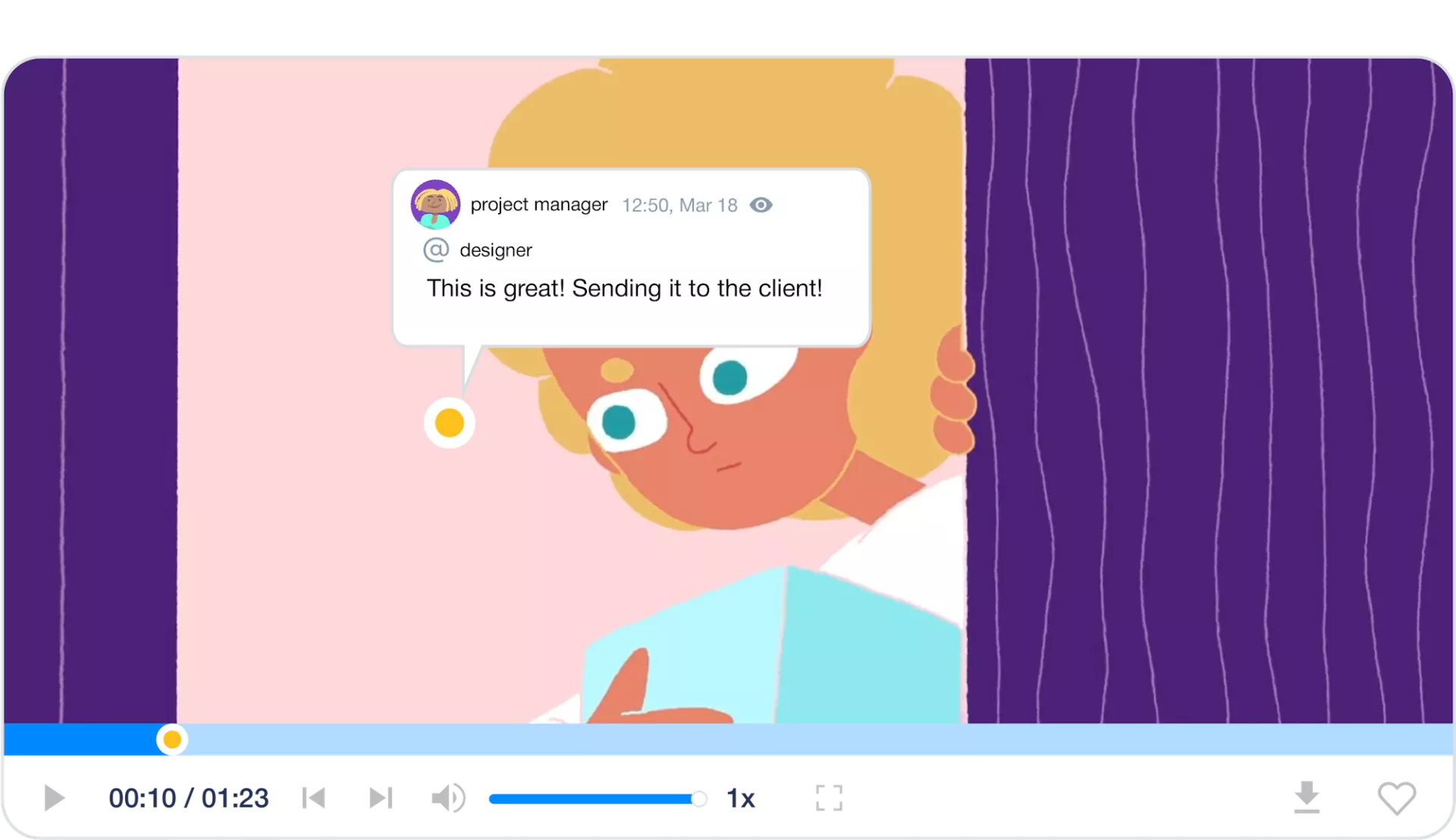
Online proofing for creative teams that generates a single review link per deliverable consolidates all notes in context. Every stakeholder’s annotations appear on the same version, ordered by timestamp, visible to the entire production team in one view. No synthesis required.
The channel discipline matters as much as the tool. If the team accepts email feedback alongside the review platform, the platform solves nothing — it becomes a second inbox instead of the single source. If you are still choosing that platform, our comparison of video collaboration tools breaks down reviewer access, pricing and NLE integrations.
Challenge 3: Revision requests that expand scope
A common pattern in client-team collaboration: the client submits feedback at revision round 2 that introduces new creative direction rather than correcting what was presented. “Can we try a completely different color palette?” or “Actually, can we see a version without the voiceover?” These aren’t revisions — they’re new briefs delivered mid-project.
Without structure, scope creep via revision requests is invisible. Each round looks like a legitimate revision cycle; the cumulative effect is a project that’s expanded by 40% without any corresponding budget discussion.
The fix: Define revision rounds in the project agreement with clarity about what constitutes a revision versus a new scope item. A revision addresses something in the approved brief that wasn’t executed correctly. A scope change introduces a new creative direction not specified in the brief.
For understanding how to manage client video revisions systematically — including the contractual structures that protect both the studio and the client relationship — a structured approach prevents the gradual accumulation of unpaid scope that erodes project profitability.
When a scope expansion request arrives in round 2, respond with a revision count reminder and a scope change note: “This is a change from the approved direction — happy to explore it as a new scope item. Let’s finish revisions on the current version first so this project stays on track.”
Challenge 4: Too many people with approval authority
Projects with multiple client-side stakeholders often fail because everyone has de facto veto power but no one has clear decision authority. The designer, the marketing director, the CEO, and the legal team all review the same cut and leave conflicting notes. The production team picks a direction, revises, and discovers that the marketing director’s notes are now contradicted by the CEO who reviewed for the first time in round 3.
The fix: Establish a single named approver on the client side before the project begins. This person consolidates all internal stakeholder feedback before submitting a round of revisions. Other stakeholders can still review and contribute — their feedback goes to the approver, who has the responsibility of synthesizing it into a single, non-contradictory set of notes.
Video proofing with role-based access supports this: you can set who can approve and who can comment. The approver’s action is the one that formally closes a revision round. Other reviewers’ comments are visible and valuable, but approval is assigned to one person.
Document this in the kickoff email: “For this project, [Name] will be our primary contact and has approval authority. All internal feedback should be consolidated through [Name] before submitting each revision round.”
Challenge 5: Internal team miscommunication before client review
Before anything goes to the client, the internal team needs to align. An animation agency’s creative director, producer, and account manager may all have different views on whether a cut is ready for client submission — and those disagreements can leak into the client-facing review in the form of contradictory explanations or hedging.
The fix: Run an internal review round before every external submission. The internal team resolves all disagreements and aligns on what the work is and how to present it before the client sees anything.
Keeping internal notes separate from client-visible notes is critical here. An internal annotation that reads “not sure about this section — might be too long” should not appear in the client review link. Online proofing for creative teams with separate internal and external annotation visibility ensures that internal working notes stay internal. The client receives one organized, resolved presentation — not a window into the team’s unresolved debate.
Challenge 6: Version confusion in revision cycles
“Which version did we approve last Thursday?” is one of the most common questions in creative production, and the answer is almost never immediately available in a scattered communication environment. The version that was approved is buried in an email thread, and the version currently in production may or may not be the same one.
Version confusion produces rework (revisions applied to the wrong cut), missed notes (feedback that was given on a version that was replaced), and disputes (client claims approval was for a different version than what was delivered).
The fix: Upload every revision as a new version in the same project, not as a separate file or email attachment. Version 1 was the first client submission. Version 2 addresses round 1 feedback. Version 3 addresses round 2 feedback. Each version is timestamped and labeled. The approval is attached to a specific version in the project history.
This version control discipline means the answer to “which version did we approve last Thursday?” is instantly available in the project history — not in an email thread that no one wants to reconstruct.
Challenge 7: Lack of structure in projects with multiple deliverables
Multi-deliverable campaigns — a hero video, three social cuts, a radio edit, print assets, and a landing page — are where project structure problems compound. Each asset has its own review cycle, its own stakeholders, and its own approval status. Without a coordinated view, some assets get approved and move to delivery while others are still in revision, and no one has a clear picture of overall project status.
The fix: Organize all deliverables for a campaign or project in a single workspace with a clear pipeline structure. Each deliverable has a stage (in production, in review, approved, delivered) and an owner. The production manager can see the full status of every asset across every stage in one view.
An interactive Gantt chart across all deliverables adds a time dimension: which assets are on track, which are at risk of missing their delivery date, which have upstream dependencies that haven’t cleared yet. The project manager sees problems before they become delivery delays.
Conclusion
The client collaboration challenges that slow down creative teams most consistently — miscommunication, version confusion, scope creep, multi-stakeholder chaos — are not communication failures. They’re process failures. The same creative team, working with the same clients, produces dramatically better outcomes when the workflow is structured.
The structural fixes are consistent: one brief approved before production, one feedback channel, one named approver, one version per round, one place for all project status. None of this requires a new tool. It requires discipline applied consistently — and tooling that makes the discipline easy to maintain.
Build a client collaboration workflow that actually works. Try Krock.io free — unlimited reviewers, structured feedback, version tracking, no credit card required.