



Updated September 28, 2026: pricing re-checked for every tool, Frame.io reviewer access corrected, new definition and FAQ added.
TL;DR:
- The best video collaboration tools for creative teams are purpose-built video review platforms, not general conferencing or file-storage apps.
- Top pick: Krock.io: frame-accurate comments, unlimited external reviewers, DaVinci Resolve and Final Cut Pro integrations, and $100/month for 10 users vs. Frame.io’s $250.
- Avoid mixing general collaboration apps (Slack, Dropbox, Google Drive) into this search. They belong in a different category.
Most teams searching for a video collaboration platform end up choosing the wrong category of software.
They search “best video collaboration tools,” scan the top results, and find a list that mixes Slack, Dropbox, and Google Drive alongside Frame.io and Vimeo Review. These are not the same category of tool. Using Slack to manage client feedback on a video cut is like using a whiteboard to track a spreadsheet: you can do it, but you create a second job out of something that should run in the background.
This guide is specifically for video production teams, agencies, and studios who need to collect precise, trackable feedback on actual video work. If you need a conferencing app for remote meetings, this comparison won’t help you.
We tested eight tools over three weeks in June 2026, evaluating frame-accurate commenting, version history, external reviewer access, NLE workflow integrations, and approval workflows. Here’s what we found.
What is a video collaboration platform?
A video collaboration platform is software where a production team and its clients review video in one place. Reviewers leave comments pinned to a timecode or frame, editors upload new versions and compare them with earlier cuts, and each file moves through approval stages until it’s approved. Unlike file sharing or video calls, the feedback stays attached to the video itself.
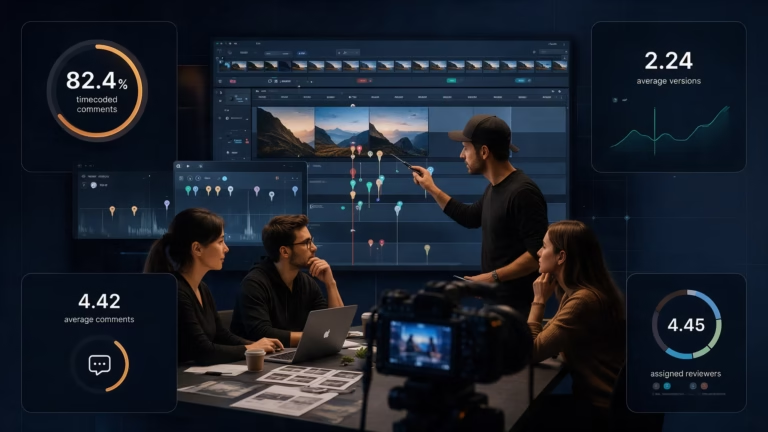
Good video collaboration software covers four jobs: collecting precise feedback, tracking which notes are resolved, keeping every version in one history, and getting a clear approval at the end. Across Krock.io projects, files go through an average of 2.24 versions and 82.4% of comments are timecoded to a specific moment (video review statistics), which is why a shared, versioned workspace matters more than another chat thread.
Two types of video collaboration tools (and why the distinction matters)
“Video collaboration” covers two genuinely different things, and the confusion between them costs teams real time.
General collaboration and file-sharing tools (Slack, Dropbox, Google Drive, Microsoft Teams) let teams communicate about video work. They don’t provide a structured way to collect, track, or resolve feedback on the video itself. A Slack thread with timestamp callouts becomes useless the moment a new version is uploaded. Feedback gets buried in notifications. No one knows what’s been addressed and what hasn’t.
Video review and collaboration platforms (Krock.io, Frame.io, Vimeo Review, Filestage) are built for the feedback loop. Reviewers leave time-coded or frame-accurate comments directly on the video. Editors see which notes have been resolved, compare versions side by side, and route content through configurable approval stages. This is the category that actually reduces revision rounds.
Throughout this guide, “video collaboration tools” refers to the second category. Generic team tools appear once, in this section, because they belong in a different conversation entirely.
Need a quick recommendation? Krock.io’s video review platform handles frame-accurate feedback, unlimited client reviewers, and NLE integrations in one place. Free plan, no credit card required.
The best video collaboration tools in 2026
We tested eight platforms: Krock.io, Frame.io, Vimeo Review, Filestage, Ziflow, Evercast, Review Studio, and Dropbox Replay. The six below represent the clearest options for creative production teams, covering different team sizes, budgets, and workflow requirements.
Testing disclosure: We evaluated each tool on the Pro or equivalent paid plan in June 2026, running active review projects across each platform. Testing covered frame-accurate commenting, version management, external reviewer access, NLE integration, and approval workflow configuration. Limitations noted below reflect our actual testing observations. Pricing was re-checked on each vendor’s pricing page in September 2026.
| Tool | Best for | Price (10 users/month) | Free external reviewers | NLE integration |
|---|---|---|---|---|
| Krock.io | Video production teams, agencies | $100 | Yes | DaVinci, Premiere Pro, FCP |
| Frame.io | Adobe-native post-production | $250 | Yes (share links) | Adobe CC |
| Vimeo Review | Marketing teams, external sharing | Varies by plan | Yes | None |
| Filestage | Multi-format agency review | $199 (Starter, flat) | Yes | None |
| Ziflow | Enterprise approval workflows | $199 (Standard, 15 users, annual) | Yes | None |
| Evercast | Live director-editor sessions | Custom | No | Limited |
Krock.io — best overall for video production teams
Tested on: Pro plan ($10/user/month), June 2026
Krock.io was built by people who ran an animation studio before building a review platform. That context shows up directly in the feature set: frame-accurate comments that pin to the exact frame (not a timestamp range), async video feedback where reviewers record directly inside the project, integrations with DaVinci Resolve Studio, Adobe Creative Cloud, and Final Cut Pro, and pricing that stays predictable as your team and client roster grow.
What works well:
- Frame-accurate comments tied to the specific frame, with on-screen drawing tools for visual annotation
- Unlimited external reviewers on every plan: clients leave comments without paid seats or account creation
- Async video comments: reviewers record face cam or screen share and attach it directly to the version they’re reviewing, not to a separate Loom thread
- NLE integrations for DaVinci Resolve Studio, Adobe Premiere Pro, After Effects, and Final Cut Pro
- Side-by-side version comparison with comment threads preserved across all previous cuts
- Storyboard and animatic tools built in, covering pre-production through final approval
What to consider:
- The breadth of features (storyboard, animatic, audio annotation, project management alongside review) means first-time users benefit from 30-60 minutes of setup before inviting clients
- 4K video playback requires the Pro plan; the free tier doesn’t include it
Pricing: Free plan (1 user, 2 projects, 2 GB, unlimited reviewers). Pro at $10/user/month includes unlimited projects, no cap on team size, and 2 TB storage. At 10 users: $100/month. The Unlimited plan starts at $400/month for 100 users. See Krock.io pricing.
Our pick for: Any video production agency, animation studio, or in-house team where multiple clients or stakeholders review work and the internal team keeps growing. Also the strongest choice for teams using DaVinci Resolve or Final Cut Pro as their primary NLE.
[SCREENSHOT: Krock.io video review interface showing frame-accurate comment pinned to specific frame, with drawing annotation]
Frame.io — best for teams inside the Adobe ecosystem
Tested on: Team plan, June 2026
Frame.io is the market leader in video review, and the native Adobe integration justifies that position for shops living inside Premiere Pro and After Effects. Editors can upload directly from Premiere Pro or After Effects without leaving the NLE. The product is polished.
What works well:
- Native Premiere Pro and After Effects panel: the tightest NLE integration in this category
- Free share links: external reviewers can view and comment without signing up or taking a paid seat
- High-resolution playback optimized for broadcast-quality and HDR content, with 4K on every paid plan
- Extensive access controls and watermarking across all paid tiers
- Large ecosystem of third-party integrations
What to consider:
- Seat caps: Pro stops at 5 members and Team at 15, so a growing agency moves to custom Enterprise pricing sooner than it might expect
- Every internal team member costs $15–$25/month. At 10 users, Frame.io costs $250/month vs. Krock.io’s $100/month. See our Frame.io pricing breakdown for worked examples by team size
- No DaVinci Resolve support in Frame.io V4: the old Blackmagic-built integration only works with Frame.io Legacy, so Resolve teams upload manually and import comments as an EDL (Frame.io help)
- No storyboard or pre-production tools; teams still need a separate tool for production management
Pricing: Free (2 members, 2 GB). Pro $15/member/month (up to 5 members, 2 TB). Team $25/member/month (up to 15 members, 3 TB). Enterprise custom. At 10 users: $250/month. Source: Frame.io pricing.
Our pick for: Teams fully embedded in Adobe Creative Cloud who need the deepest native Premiere Pro or After Effects integration and can absorb the per-member cost and seat caps as the team grows.
[SCREENSHOT: Frame.io panel inside Adobe Premiere Pro showing direct upload and comment view without leaving NLE]
Vimeo Review — best for marketing teams sharing externally
Tested on: Advanced plan, June 2026
Vimeo Review is a review layer built on top of Vimeo’s hosting platform. It handles the basics cleanly: timestamped comments, version uploads, review links, status labels, and password-protected sharing. For a marketing team managing campaign video approvals where clients aren’t video professionals, it covers the essentials without overwhelming them.
What works well:
- Low-friction reviewer experience for clients with no video production background
- Ad-free, high-quality video hosting and review in a single subscription
- Password-protected review links with expiration dates
- Timestamped comments visible to all reviewers without account creation
What to consider:
- Annotation tools are minimal: no drawing tools, no frame-accurate precision, no on-screen markup
- No approval workflow configuration beyond basic status labels
- No NLE integration; files must be exported and uploaded manually
- The value proposition is strongest for existing Vimeo hosting subscribers. As a standalone review tool, Krock.io or Filestage provide more workflow control
Pricing: Review features are included in Vimeo’s paid plans. Seat costs vary by plan, so check Vimeo’s pricing page for your team size.
Our pick for: Marketing teams already paying for Vimeo hosting who need a lightweight approval step for campaign videos and simple client-facing sharing.
[SCREENSHOT: Vimeo Review page showing timestamped comment thread and version comparison]
Filestage — best for multi-format creative review
Plans reviewed: Starter and Business, September 2026
Filestage is an online proofing platform that handles video alongside PDFs, images, audio files, and HTML assets. For agencies managing mixed-format deliverables, keeping everything in one review environment eliminates the context-switching that kills approval cycle momentum.
What works well:
- Single workspace for video, PDFs, images, audio, and HTML: the most complete multi-format coverage in this list
- Clean client-facing interface with minimal onboarding friction for non-technical reviewers
- Configurable review stages with automated deadline reminders
- Unlimited reviewers on every plan, and unlimited active projects on paid plans
What to consider:
- Video commenting is timestamp-level rather than frame-accurate: feedback lands “around 0:12” rather than on the exact frame. For motion-heavy or animation work, this matters
- Advanced compare mode (overlay and text comparison) is on the $329/month Business plan; Starter includes basic side-by-side comparison
- No NLE integration; requires manual upload
- The free plan allows one active project at a time, so it works as a trial rather than an ongoing option
Pricing: Free (1 active project, 2 GB). Starter $199/month (1 TB). Business $329/month (3 TB). Enterprise custom. Annual billing saves two months. Source: Filestage pricing.
Our pick for: Agencies managing a high volume of mixed-format deliverables where a single review environment covers video, print, and digital assets in one client-facing project.
[SCREENSHOT: Filestage project view with video, PDF, and image assets side by side in one review workspace]
Ziflow — best for enterprise teams with formal approval workflows
Plans reviewed: Standard and Pro, September 2026
Ziflow is designed for organizations where approvals follow formal routing rules: multi-stage approvals with configured sequences, detailed audit trails, and automated notifications. It handles video review alongside other asset types within an enterprise content operations framework.
What works well:
- Multi-stage approval workflow configuration with conditional routing and automatic reminders
- Comprehensive audit trail and unlimited review history on paid plans
- Strong access controls and watermarking for sensitive content
- Wide file type support alongside video
What to consider:
- The workflow configuration setup requires investment before the tool pays off: teams that don’t configure stages and routing rules upfront won’t see the benefit over simpler tools
- Workflow stages are capped by plan (2 on Standard, 3 on Pro, unlimited only on Enterprise), so complex routing pushes you up a tier
- No NLE integration
- Video annotation is functional but less refined than Krock.io or Frame.io
Pricing: Personal free (2 users, 2 GB). Standard $199/month billed annually (15 users, 1 TB). Pro $329/month billed annually (20 users, 2 TB). Enterprise custom. Unlimited reviewers on every plan. Source: Ziflow pricing.
Our pick for: Enterprise marketing departments or production companies where formal multi-stage approvals, compliance requirements, and audit trails outweigh the need for NLE integration or pricing flexibility.
[SCREENSHOT: Ziflow approval workflow builder showing multi-stage routing configuration]
Evercast — best for live synchronized review sessions
Tested on: Studio plan, June 2026
Evercast is a different kind of tool: it streams the editor’s NLE screen in real time, letting a remote director, colorist, or client watch cuts play out live and leave synchronized comments during the session. It replicates the in-room review experience for distributed post-production teams.
What works well:
- Real-time synchronized playback of the editor’s NLE screen with sub-100ms latency
- Built-in video conferencing alongside the live review stream
- Purpose-built for color grading, sound mix, and cut review sessions where sync is critical
- Clean integration with most NLE environments via screen share
What to consider:
- Not an async tool: Evercast requires all reviewers available simultaneously, which limits it to scheduled sessions. Asynchronous feedback collection requires a different platform running alongside it
- Pricing is custom and opaque without a direct quote
- For teams collecting feedback from multiple stakeholders on their own schedules, async tools deliver more practical coverage
Pricing: Custom. Contact for pricing.
Our pick for: Distributed post-production teams running live director-editor or director-colorist review sessions. Not a replacement for async feedback collection across larger reviewer groups.
How Wipster compares to the tools above
Wipster is a video-first review platform aimed at small teams and freelancers. The Light plan starts at $9.95/month billed annually, and the Team plan is $19.95/user/month (Wipster pricing). It covers the basics (timestamped comments, version uploads, client review links) with a clean, uncluttered interface that has a low learning curve.
The limitation is scope. Wipster doesn’t offer NLE integrations or a flat-fee model for larger teams. It’s a reasonable entry point for a solo editor or very small team who needs simple client sharing, but it scales less cleanly than Krock.io or Filestage as the reviewer count or project volume grows.
If you’re specifically evaluating Wipster against alternatives, the Wipster alternatives comparison covers the full breakdown by use case and team size.
NLE integrations compared
For post-production teams, the right video collaboration tool is often the one that fits inside the editing environment. Manually exporting, uploading, reviewing, and tracking changes back through the timeline adds four steps to every iteration cycle.
| NLE | Krock.io | Frame.io | Vimeo | Filestage |
|---|---|---|---|---|
| Adobe Premiere Pro | Yes (plugin) | Yes (native panel) | No | No |
| After Effects | Yes | Yes (native panel) | No | No |
| DaVinci Resolve Studio | Yes (plugin) | No (V4; EDL import only) | No | No |
| Final Cut Pro | Yes (plugin) | No | No | No |
| Manual upload | Yes | Yes | Yes | Yes |
Frame.io has the deepest Adobe integration: the native Premiere Pro panel is part of the Adobe Creative Cloud subscription, making it a genuinely frictionless experience for Adobe-centric studios. Krock.io covers a wider range of NLEs and is the only platform in this comparison with both a working DaVinci Resolve Studio plugin and a Final Cut Pro plugin.
Take a common scenario: a post-production team moves its editors from Premiere Pro to DaVinci Resolve. The review tool they picked for its Adobe panel now sits outside the new workflow, and every cut goes back to export, upload, and copy notes by hand. With a review platform that has a Resolve plugin, the editor sends the cut straight from Resolve and the comments come back into the editing workspace, tied to the version they were left on.
For teams using DaVinci Resolve or Final Cut Pro as their primary NLE, Krock.io’s multi-NLE coverage is the clearest differentiator in this category.
How to choose the right video collaboration platform for your team
Reviewer count: Every platform in this list except Evercast lets external reviewers comment through a link without a paid seat. The real cost difference is internal: Krock.io charges $10 per team member with no team-size cap, Frame.io charges $15–$25 per member and caps plans at 5 or 15 members, and Filestage and Ziflow charge a flat monthly fee.
File type mix: Teams reviewing only video can optimize for a video-first platform. Agencies managing mixed deliverables (video alongside PDFs, images, banner ads) will get more value from Filestage or Ziflow’s multi-format coverage.
NLE stack: Choose based on where your editors live. Adobe-native shops: Frame.io. DaVinci Resolve or Final Cut Pro teams: Krock.io. Teams using a mix of NLEs: Krock.io covers the most ground.
Async vs. sync: Most teams benefit from async-first platforms that don’t require everyone online simultaneously. Evercast is purpose-built for the specific case of live director-editor sessions, but it doesn’t replace async feedback collection.
Budget: At 10 users, the cost difference between these tools is significant. Krock.io at $100/month, Filestage at $199/month, Ziflow at $199/month (billed annually), Frame.io at $250/month. Over a 12-month period, the gap between Krock.io and Frame.io for a 10-person team is $1,800.
Workflow complexity: Krock.io and Filestage get teams operational within an hour. Ziflow requires a proper workflow configuration session before the multi-stage routing delivers value. Match tool complexity to team bandwidth.
If you’re comparing tools for the first time, the best video review software guide covers the broader category, including a few platforms not listed here. And if Frame.io is your current platform, the Frame.io alternatives comparison walks through the specific migration scenarios by team type.
Frequently asked questions about video collaboration tools
What is a video collaboration platform?
A video collaboration platform is software where teams and clients review video in one shared workspace. Reviewers leave comments pinned to a timecode or frame, editors upload and compare versions, and files move through approval stages. It replaces scattered email, chat, and file-sharing feedback with one tracked history per video.
What is the best video collaboration tool for creative teams?
For most creative production teams, Krock.io is the strongest all-around option: frame-accurate review, unlimited external reviewers on every plan, NLE integrations for DaVinci Resolve, Premiere Pro, and Final Cut Pro, and $100/month for a 10-person team. Frame.io is the right alternative if your team is fully embedded in Adobe Creative Cloud and the native Premiere Pro integration outweighs the higher per-member cost.
What features should video collaboration software have?
Look for frame-accurate or timecoded comments, on-screen drawing, version history with side-by-side comparison, free access for external reviewers, approval stages, and integrations with your editing software. If your editors work in DaVinci Resolve or Final Cut Pro, check for a plugin, because most tools only integrate with Adobe.
What is the difference between video collaboration software and video conferencing?
Video conferencing tools (Zoom, Google Meet, Teams) enable real-time communication. Video review and collaboration platforms (Krock.io, Frame.io, Filestage) collect structured, tracked feedback directly on video assets: timestamped or frame-accurate comments, version comparison, resolution tracking, and configurable approval stages. Using a conferencing tool for creative review produces feedback that is unstructured, unresolvable, and invisible the moment a new version is uploaded.
Is there a free video collaboration tool for creative teams?
Krock.io’s free plan includes 2 projects, unlimited reviewers, video and media review, the storyboard tool, and 2 GB of storage with no credit card required. Filestage has a free plan limited to one active project and a 14-day trial of paid plans. Frame.io’s free tier caps at 2 GB and 2 team members, which rarely fits a real client review workflow.
How does Wipster compare to Krock.io and Filestage?
Wipster covers the basics (timestamped comments, version uploads, client sharing) at a lower entry price, from $9.95/month billed annually. The trade-offs are no NLE integrations and less workflow depth than Krock.io or Filestage. It works well for solo editors or very small teams with simple review needs. For agencies or production teams managing multiple clients and higher reviewer counts, Krock.io or Filestage offer more room to grow. The Wipster alternatives comparison covers the full side-by-side.
Do clients need a paid account to leave video feedback?
No, not with the main platforms. Krock.io, Frame.io, Filestage, and Ziflow all let clients comment through a review or share link without a paid seat. The cost difference is in your own team: Krock.io charges $10 per internal user, Frame.io $15–$25 per member with seat caps, and Filestage and Ziflow a flat monthly fee.
The right video collaboration tool doesn’t just collect feedback — it makes feedback actionable
Most “best video collaboration tools” lists mix storage apps with review platforms, recommend discontinued tools, and confuse video conferencing with video review. The result is teams choosing the wrong category and then wondering why revision rounds aren’t getting shorter.
The tools in this guide are all purpose-built for structured creative feedback: timestamped or frame-accurate comments, version comparison, approval workflows, and reviewer access that doesn’t inflate the monthly bill.
For most creative production teams, the decision comes down to two platforms:
Choose Krock.io if you need unlimited reviewer access, integration with DaVinci Resolve or Final Cut Pro alongside Adobe, and a tool that covers storyboard through final delivery at a predictable cost. At $100/month for 10 users, it’s the most complete option in this price range.
Choose Frame.io if your team lives inside Adobe Premiere Pro or After Effects and the native Adobe integration is the non-negotiable requirement. Budget for per-member seats and the 15-member cap on the Team plan as you grow.
Start a free Krock.io trial: no credit card required, unlimited reviewers from day one. Add a live project, invite your client, and compare what the next revision round looks like when all the feedback lands in one place.