


Video review is the process of watching, evaluating, and collecting feedback on video content before it’s approved and delivered. It covers every feedback round from rough cut to final sign-off — and it’s the stage where most creative projects lose time, client trust, and unbilled revision rounds. According to Wyzowl’s State of Video Marketing, 91% of businesses now use video as a marketing tool, which means the volume of content requiring structured review has grown faster than most teams’ processes for handling it. This guide covers video review as a production process — how creative teams collect structured feedback on video projects before delivery — not customer testimonials or ecommerce product review videos.
This guide explains how video review works when it’s done well, what breaks it, and what to look for in the tools that run it.
Three days before a product launch, the feedback arrived. The client emailed six bullet points. The brand manager left a comment on a Vimeo link that had expired. The creative director sent a voice note. And someone on the client’s legal team replied-all to an email from two weeks ago with notes on a version that had already been changed four times.
The editor stared at 19 pieces of feedback across six channels, half of which contradicted each other, with no way to tell which applied to the current version. If you’ve been on either side of that situation, you already know why a structured video review process matters.
What is video review?
Video review is the stage where a rough cut, final edit, or motion graphics piece is shared with stakeholders, comments are gathered, revisions are made, and the cycle repeats until the work meets the agreed standard and receives formal sign-off.
In a production pipeline, video review happens multiple times. A rough assembly goes to the director. A revised cut goes to the client. A near-final version goes to legal, brand, or an executive stakeholder. Each round generates a new set of notes, the editor makes changes, and the next version comes back for another pass.
Done well, video review is fast, organized, and produces better work. Done poorly, it’s one of the biggest time sinks in creative production.
Want to see how a structured video review workflow works in practice? Krock.io’s video proofing software keeps all feedback in one place, with frame-accurate comments and version history built in. Free to start, no credit card required.
Why email and chat break the video review process
The default review “workflow” at most agencies goes like this: export a file, drop it in Dropbox or Google Drive, share a link, and wait. Feedback arrives however it wants to. Email. Slack. A PDF with annotations. A photo of a printed frame with handwriting on it.
The problem isn’t the people. It’s that feedback has no home, so it ends up everywhere.
Here’s what that costs in real terms. Take a 90-second explainer video for a mid-size B2B client. Three to five stakeholders on the client side. Four to six revision rounds. Each round generates feedback from multiple people through multiple channels. By round three, the editor is managing 60 to 80 individual pieces of input scattered across five places, some of which conflict, and none of which are clearly tied to a specific version.
That’s before considering the time spent chasing “did you actually approve that?” confirmations.
Teams using visually anchored, time-coded feedback consistently report fewer revision rounds than teams collecting feedback by email or text alone. The tools teams use to collect feedback directly affect the quality of feedback they receive.
How a structured video review process works
A video review cycle moves through four stages, then repeats:
- Share — the editor uploads a version and sends a link to the right reviewers for that round.
- Collect feedback — reviewers leave time-coded comments pinned to specific frames.
- Consolidate — the team reviews all feedback together before touching the timeline.
- Revise — changes are made and a new version is uploaded, preserving the previous version and its full comment history.
At the end of each loop, an explicit approval is logged — not implied.
The difference between a smooth production and a chaotic one is almost always whether these stages stay distinct, or whether they collapse. Revisions made before all feedback is collected produce rework. Approvals assumed from a Slack thumbs-up produce disputes.
For a step-by-step guide to building this process from scratch, including how to stage reviews, handle conflicting feedback, and set up approval gates, the video review workflow guide covers the full setup in detail.
Common video review problems and how to fix them
Even teams with clear intentions run into the same recurring issues. Recognizing them makes them easier to prevent.
Scattered feedback. Feedback arriving through five different channels is the most consistent source of extended revision cycles. The solution is establishing one feedback location before a link is sent, not trying to consolidate notes after they’ve already arrived in every possible format.
Version confusion. “Can you pull up the version before this one?” is a phrase that should never need to be said. Proper version management means every upload is archived automatically with its full comment history. Reviewers can switch between versions at any point.
Informal approvals. “I thought you approved this” is a project-destroying phrase. A thumbs-up emoji in a Slack thread is not an approval record. The review workflow needs a defined approval step that logs who signed off, on what version, at what time.
No staged review. Sending a video to 12 stakeholders simultaneously and asking everyone for notes produces contradictory, overlapping feedback. Staged review, where internal team feedback is resolved before the client sees the work, and where client feedback is consolidated by one point of contact, cuts revision rounds significantly.
Friction for external reviewers. Asking clients to create an account just to leave a comment adds a step that a surprising number of people won’t take. Guest access, where a reviewer can click a link and start annotating without logging in, removes that barrier entirely.
Javi runs a six-person video agency in Barcelona. His team produces campaign content for four to eight retail clients at a time. Before centralizing reviews, each project had feedback scattered across email threads, WhatsApp, and a shared spreadsheet where clients typed timecodes manually.
5.3 → 2.1 revision rounds. After switching to a platform with frame-accurate comments and per-project feedback consolidation, Javi’s average revision rounds dropped from 5.3 to 2.1. The clients hadn’t changed. The workflow had.
What to look for in video review software
Two features separate useful video review tools from everything else.
The first is frame-accurate comments. Reviewers should be able to click on the video to attach their note to a specific timecode, not type a description and hope the editor interprets it correctly. This single feature eliminates more back-and-forth than any other.
The second is reviewer pricing. Several platforms charge per reviewer seat, which means every client stakeholder added to a project increases the monthly bill. Look for tools that charge per creator (the people doing the editing) and allow unlimited external reviewers. For growing agencies, that distinction is the difference between a predictable cost and an unpredictable one.
Beyond those two, the features that determine whether a tool fits a real production pipeline:
| Feature | Why it matters |
|---|---|
| Version history | Every upload is archived with its full comment thread intact |
| Guest access | External reviewers comment without creating an account |
| Formal approval tracking | Logs who signed off, on which version, at what time |
| Mixed media support | Handles images, audio, and PDFs alongside video in one workflow |
For a detailed breakdown of the leading platforms, including how they compare on pricing, storage, and reviewer policies, the best video review software guide covers them side by side.
Video review best practices for creative teams
Beyond the tools, the habits that matter most are consistent across team size and project type.
Define roles before sharing. Before a link goes out, establish who is reviewing (and in what order), what kind of feedback is in scope for this round, and who has final approval authority. This prevents contradictory feedback from stakeholders who had no brief for what they were looking at.
Set a feedback deadline. An open-ended review invitation produces an open-ended timeline. A 48-hour or 72-hour window respects everyone’s schedule and keeps the project moving. Build that deadline into the share message.
Keep internal and client feedback separate. Director notes and client notes serve different purposes at different stages. Review platforms that let you toggle comment visibility between team-only and client-facing views keep those conversations from crossing.
Use async video comments for complex feedback. Some creative direction is impossible to type clearly. “The pacing feels wrong in the middle section” is a sentence that means something different to every editor who reads it. A short screen-recording or face-cam comment showing what “wrong pacing” actually sounds like saves a revision round. Krock.io’s video comments feature lets reviewers record and attach async feedback directly to a project without leaving the platform.
Review the storyboard before animating. For animation and motion graphics, this is typically the most impactful change a team can make to reduce total revision rounds. Getting client approval on a storyboard costs almost nothing to revise. Getting client approval on a rough cut, after a week of animation work, can cost days. A storyboard review stage, before production begins, consistently reduces total revision rounds.
For a step-by-step walkthrough of the full approval chain from intake to delivery, the review and approval process guide covers each stage in detail.
Video review with remote and distributed teams
Remote teams add timezone complexity to a process that already has a lot of moving parts. The good news is that structured video review works well for async teams — frame-accurate comments don’t require both parties to be online at the same time.
A reviewer in Toronto can leave frame-accurate comments at 9 a.m. An editor in Warsaw can open those comments at 3 p.m. and respond with replies attached to the same timestamps. No meeting required. No one waiting for a screen-share call that gets rescheduled twice.
The challenge specific to async review is comment discipline. With reviewers across multiple timezones, it’s easy for notes to keep arriving after the editor has already started making changes. A firm feedback window, clearly communicated in the share message, prevents that. Reviewers who miss the deadline get addressed in the next round, not in the middle of the current one.
For multi-client teams managing distributed workflows, online proofing for creative teams offers a structured approach to keeping projects organized without requiring real-time availability.
Frequently asked questions about video review
What’s the difference between video review and video proofing?
The terms are often used interchangeably, but they describe different stages. “Video review” is the broader process covering all feedback rounds from rough cut through final approval. “Video proofing” typically refers to the formal quality-check stage immediately before delivery, focused on technical accuracy alongside content sign-off. Most modern platforms handle both under one workflow.
Do clients need an account to leave feedback?
With most dedicated video review platforms, no. Clients receive a shareable link and can leave time-coded comments without signing up or installing anything. The reviewer’s account belongs to the creative team.
How many rounds of revision is normal?
Industry norms vary by project type, but two to three rounds is a reasonable target for most projects with clear briefs and structured review processes. Teams averaging five or more rounds typically have a feedback-collection problem, not a creative problem.
What’s the best format for giving video feedback?
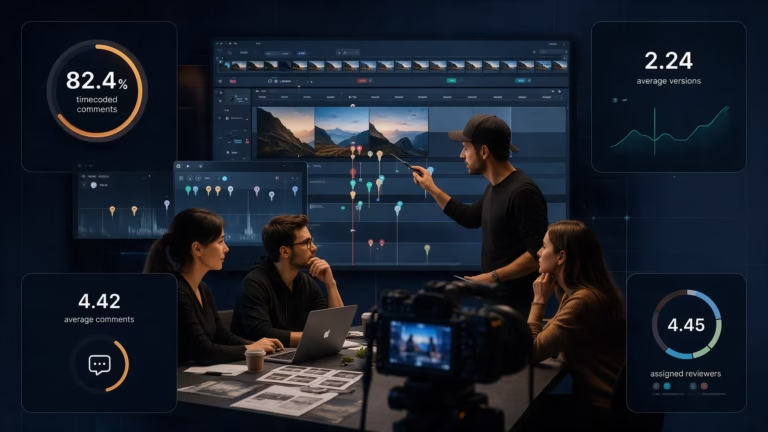
Frame-accurate, time-coded comments are the most useful format for editors. Reviewers use them when they can: 82.4% of comments on Krock.io carry a timecode (see our video review data). “At 0:34, the cut to the product shot feels too abrupt” is actionable. “The second half needs more energy” requires interpretation. The more precisely feedback is tied to a specific moment, the fewer clarification exchanges are needed before revisions begin.
How do you handle conflicting feedback from multiple stakeholders?
Before touching the timeline, consolidate all feedback and identify conflicts. Bring conflicting notes back to the relevant stakeholders for resolution before revisions begin, not during. A clear approval authority on the client side, established at the start of the project, makes this easier.
What good video review looks like
The clearest sign of a well-run video review process is that revision rounds get shorter over time, not longer. Stakeholders know what to look for, feedback lands in one place, and everyone knows what “approved” actually means before delivery.
The core principles:
- All feedback in one location, before revisions begin
- Frame-accurate comments that reference specific moments
- Version history intact across every upload
- Formal approvals, not informal sign-offs
- Staged review that separates internal notes from client-facing feedback
If your current process involves chasing feedback across email threads, Slack channels, and shared folders, a dedicated video review tool closes most of those gaps with very little setup time.
Start a free trial of Krock.io and run your first video review with frame-accurate comments, unlimited reviewers, and full version history. No credit card required, and reviewers can join without creating an account.
If you’re also evaluating other platforms before deciding, the Frame.io alternatives guide compares the main options on the criteria that matter most for creative teams.