

TL;DR
– Only about a quarter to a third of the leading companies we reviewed use a genuine hero video. The rest lean on static imagery, product screenshots, or an animated GIF dressed up to look like one.
– D2C brands and creative agencies favor short, silent, autoplay video. B2B SaaS and developer tools favor a click-to-play “watch demo” button over a product screenshot.
– AI startups and fintech companies are the least likely to use hero video at all. They lead with prompt boxes, dashboards, calculators, and quantified proof instead.
– Half of what gets called a “hero video” in roundup articles is an animated product screenshot, which is a UI animation, not a marketing video.
Type “hero video examples” into Google and you’ll find dozens of listicles implying that video-first homepages are now the default. Look at the homepages of 171 leading companies across nine industries, and a different picture shows up: most skip video entirely, and a large share of what gets counted as a hero video is an animated screenshot with a fade transition.
That distinction matters if you’re the one deciding whether to budget for a hero video, or the one being asked to produce it. This article breaks down where hero video shows up in 2026, which of two dominant formats companies use, and which industries treat video as essential versus which ones actively avoid it.
What actually counts as a hero video
A hero video, also called a homepage video or website hero video, is an explainer, product demo, or brand-story video with real marketing intent, placed above the fold. That excludes two things people commonly count: a silent, purely decorative background loop with no explanatory purpose, and an animated product screenshot or GIF, which is a UI animation rather than a video.
That second exclusion is the one most “video is everywhere” articles get wrong. Slack, Notion, Figma, Canva, and Linear all show motion in their hero section, an animated interface cycling through features, but none of it is a video with a beginning, middle, and end. It’s a moving screenshot.
The most-cited benchmark for hero video adoption comes from ChartMogul’s 2017 analysis of 100+ SaaS landing pages, which found that 53% used video “to convey product value to the user as quickly as possible.” That study also identified the two formats that still describe the market: a click-to-play button over a static image, and a silent, looping video background. The number is nine years old and gets recycled in current roundups as if it were fresh. Treat it as a directional benchmark, not a 2026 measurement.
The two hero video formats that dominate in 2026
Almost every genuine hero video on the web today falls into one of two patterns, and which one a company uses depends almost entirely on its audience.
Autoplay, muted, live-action. A 6 to 12-second looped background film, self-hosted as an HTML5 file with a static poster-frame fallback for slow connections. No sound, no narration, just a cinematic loop. Looking for video background website examples? Supergoop!, Polaroid, and Oishii all use this format: short product or brand films that play the instant the page loads and never ask for a click.
Click-to-play, animated or screen-recorded. A play button sits over a product screenshot. Clicking it opens a 30 to 120-second explainer or demo video, often embedded from YouTube, Vimeo, or Wistia. Loom, Retool, and GitLab use this pattern: the video is optional, narrated, and built to answer “how does this actually work?”
| Format | Typical length | How it’s triggered | Who uses it |
|---|---|---|---|
| Autoplay background film | 6–12 seconds | Loads automatically, muted | D2C brands, creative agencies |
| Click-to-play demo | 30–120 seconds | Viewer clicks a play button | B2B SaaS, developer tools |
Maya Ellison ran production at a nine-person branding studio in Austin. In February 2026, her team pitched a moody 40-second autoplay film, cinematic lighting, no dialogue, to a fintech client launching a savings app. The client’s product lead killed it in the first review round. He wanted the homepage to show the live interest-rate calculator, not a mood reel. Maya’s team recut the brief in four days: a static hero with an embedded rate calculator, plus a click-to-play 90-second explainer tucked below it. The site launched two weeks later, and the client’s next project came without a competitive pitch.
The lesson generalizes: matching the format to the industry matters more than the production quality of the video itself.
Where hero video shows up by industry
We reviewed the documented hero-section patterns of 171 companies across nine industries, using an “informational and sales-focused video above the fold” definition that excludes decorative loops and animated screenshots. Adoption ranges below are estimates based on that review, not a live audit of every homepage on a single date, since redesigns happen constantly.
| Industry | Approximate adoption | Dominant format |
|---|---|---|
| Creative agencies | Majority (7 of 11 reviewed) | Autoplay showreel |
| D2C / consumer brands | 13–15 of 20 | Autoplay, muted, live-action |
| EdTech | 9–10 of 20 | Click-to-play explainer |
| HealthTech | 8 of 20 | Mixed: product demo or brand film |
| SaaS / B2B software | 7–8 of 20 | Click-to-play product demo |
| E-commerce platforms | 6–7 of 20 | Autoplay (builders) or click (infrastructure) |
| Developer tools | 6–7 of 20 | Click-to-play product demo |
| Fintech | 3–4 of 20 | Autoplay, consumer-facing only |
| AI startups | 3–5 of 20 | Click-to-play product demo |
Two patterns stand out. First, agencies and D2C brands treat the hero video as the primary sales pitch. Second, everyone else treats it as optional at best. Dollar Shave Club’s classic founder-led explainer, still one of the most-cited examples of the format, is the exception that proves the rule: it worked because the humor and specificity carried a low production budget further than most brand films manage. We break down why that campaign and others like it spread in our analysis of viral video marketing campaigns.
Why AI startups and fintech skip hero video entirely
This is the most counterintuitive finding in the data. AI startups are the most video-literate companies on the internet, and they’re also among the least likely to put a video in their own hero section.
OpenAI, Anthropic, Perplexity, Mistral, Cursor, and Midjourney all lead with a text-forward hero, a product interface, or a prompt box. Product demos exist heavily in their marketing, keynotes, YouTube channels, dedicated demo pages, but they sit below the fold, not above it. The exception is AI-media tools like Synthesia and HeyGen, where the product itself is video generation, so a demo video is the most direct way to show what the tool does.
Fintech follows a similar logic for a different reason. Wise shows a live currency-transfer calculator. Brex leads with “$50B+ spent through Brex.” Ramp claims customers “save an average of 5%.” These companies have decided that a quantified, interactive proof point converts better than a cinematic film, and they’ve built their hero section to prove a number instead of tell a story. Only their consumer-facing peers, Revolut, SoFi, and Neko Health, bring brand video back into the mix.
The takeaway for anyone pitching a hero video to a B2B fintech or enterprise AI client: expect resistance, and come with a data-backed reason, not just a creative brief.
What this means if you’re the one making the hero video
If your team is the one producing the click-to-play demo or the autoplay brand film, the industry pattern only tells half the story. The other half is what it costs to get that 12-second file or 90-second explainer through client sign-off.
At Overlook Films, an eight-person agency producing D2C brand videos, producer Josh Tran budgets four revision rounds for every 10-second autoplay hero film: one for color, one for pacing, one for the client’s legal team, and one buffer round nobody admits to needing. Before Overlook consolidated feedback into a single review platform, those four rounds arrived through email, Slack, and a shared Google Doc, and the account lead spent close to five hours a week just reconciling which note was current.
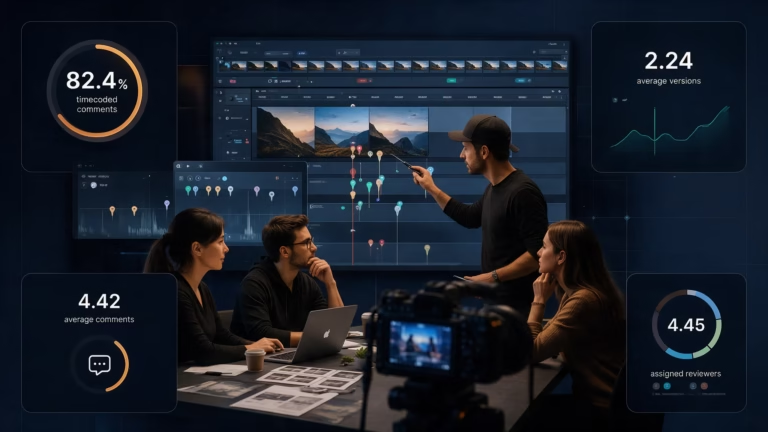
That kind of feedback fragmentation isn’t unique to Overlook. Our video marketing statistics research found that 74% of marketing and advertising professionals say the approval process takes more effort than the creative work itself, and on Krock.io the average reviewed file collects 4.42 comments across 2.24 versions. A hero video is a short deliverable, but it’s a high-visibility one: it’s the first thing every stakeholder sees, which tends to invite more opinions per second of footage than any other asset in a campaign.
If your team is producing an explainer or demo video for a client’s homepage, a structured explainer video workflow that keeps script, styleframes, and review rounds in one place is worth setting up before the first cut goes out, not after the third round of scattered feedback.
Should your homepage have a hero video? A decision framework
The industry data points to three clear answers, depending on who’s on the other side of the homepage.
D2C, consumer, or creative agency: yes. Use a short (6 to 12-second) muted autoplay film with a static poster-frame fallback for slow connections. Save narrated, sound-on brand stories for a click-to-play option instead of forcing autoplay with audio.
B2B SaaS or developer tools: yes, but click-to-play only. Put a “watch demo” button over a product screenshot. Keep the video itself to 60 to 90 seconds, and embed it through a host like Wistia or YouTube with lazy loading so it doesn’t block the page from rendering.
Fintech, healthtech, or enterprise AI: default to static. Lead with a product dashboard, a live calculator, or a quantified proof point instead. Only add hero video if the product is consumer-facing, and keep any video below the fold until you’ve A/B tested it.
The performance cost of a hero video
Before adding video to a hero section, run the numbers on page speed. Google’s Core Web Vitals guidance states that a site “should strive to have an LCP of 2.5 seconds or less for at least 75% of page visits,” and anything past 4 seconds is classified as poor. An unoptimized autoplay video, especially one without a lightweight poster frame, is one of the most common causes of a failing LCP score.
Mobile makes this more urgent, not less. Mobile devices account for roughly 60% of global website traffic as of 2025, and most mobile operating systems block autoplay video by default unless it’s muted. A hero video with no static fallback effectively shows nothing to the majority of first-time mobile visitors.
When Bramble Home, a bedding D2C brand, added a 12-second autoplay landing page video background without a compressed poster-frame fallback, their Largest Contentful Paint jumped past 4.2 seconds on mobile, deep into Google’s “poor” range. Their agency swapped in a 40 KB static poster image that loads first, with the video easing in once it’s cached. LCP dropped to 2.1 seconds within a day, and mobile bounce rate on the homepage fell 9% the following week.
The conversion upside is real but should be treated with the same caution as the adoption numbers. HubSpot cites landing page video lifting conversions by as much as 86%, though the figure traces back to a single case study and gets recycled across marketing blogs without a fresh source. It’s directional, not a guarantee, and it only holds if the video itself doesn’t tank your load time first.
Frequently asked questions
What is a hero video?
A hero video is a video with genuine marketing or sales intent, an explainer, product demo, or brand story, placed above the fold on a homepage. It excludes purely decorative background loops with no explanatory purpose and animated product screenshots or GIFs, which are UI animations rather than actual video.
Does every homepage need a hero video?
No. Across 171 companies we reviewed, only about a quarter to a third used a genuine hero video. Fintech, enterprise AI, and clinical healthtech companies mostly skip it in favor of dashboards, calculators, and quantified proof points instead.
Should a homepage hero video autoplay or require a click?
It depends on the audience. D2C brands and agencies favor short, silent, autoplay background films. B2B SaaS and developer tools favor a click-to-play button that opens a longer, narrated demo, since forcing a longer video to autoplay hurts both page speed and viewer patience.
How long should a hero video be?
Autoplay background films run 6 to 12 seconds, just long enough to loop without feeling repetitive. Click-to-play explainer or demo videos run 30 to 120 seconds, since the viewer has already opted in by clicking play.
Does hero video hurt page load speed?
It can. An unoptimized autoplay video without a static poster-frame fallback is a common cause of a failing Largest Contentful Paint score, especially on mobile, where most browsers block autoplay unless the video is muted. A compressed poster image that loads first, with the video easing in afterward, avoids the penalty.
The bottom line
Hero video is real, but it’s polarized. D2C brands and creative agencies use it because the video is the pitch. B2B SaaS and developer tools use a click-to-play version of it because buyers want proof, not a mood. Fintech and AI startups mostly skip it because a calculator or a product interface converts a skeptical buyer faster than a film does.
If you’re deciding whether to add one, match the format to your industry first, then check what it costs your Largest Contentful Paint score before you ship it. And if your team is the one producing the video, the revision rounds that follow are just as predictable as the format choice. A structured video proofing workflow that keeps every round of client feedback in one place turns a high-visibility, high-opinion deliverable like a hero video from a bottleneck into a fast approval. Start your free trial to see how it works on your next project.