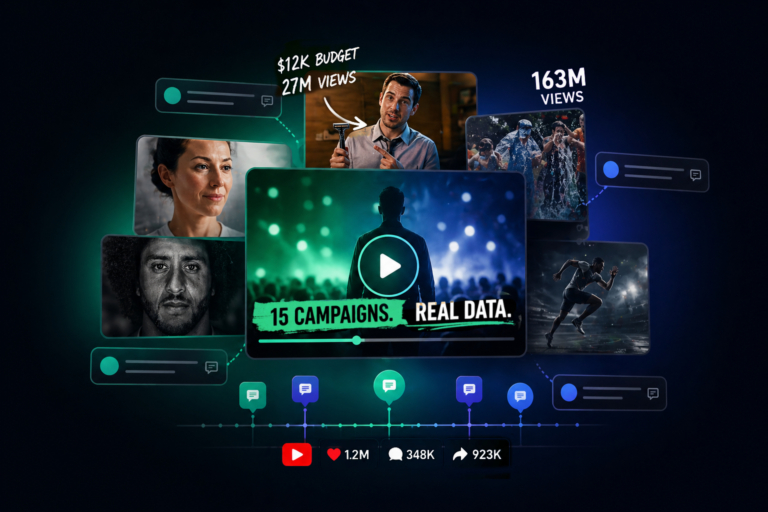



The best viral video marketing campaigns work because they trigger a specific emotion, are built for sharing, and connect to something larger than the product. Dollar Shave Club ($12,000 budget, 27 million views in 3 months), Dove Real Beauty Sketches (163 million views), and the ALS Ice Bucket Challenge ($115 million raised in 30 days) all followed the same underlying pattern — not luck, but a specific set of creative and production decisions.
What most marketing teams get wrong: they think it’s about the idea. It’s not. It’s about the idea surviving the approval process. The campaigns that broke through weren’t lightning in a bottle. They were the result of fast creative iteration, structured feedback, and production teams that could move from “good enough” to “exactly right” quickly.
This guide covers 15 of the best viral video ads and marketing campaigns ever made, with actual metrics where we have them, honest analysis of why they worked, and a framework you can apply to your own campaigns. For the broader benchmarks behind campaigns like these, see our video marketing statistics. These viral marketing campaign examples span legacy brands and digital-native companies, fast-turnaround reactive spots and years-long series. We’ve also included five examples of campaigns that failed, because the failure cases teach more than the wins.
What Makes a Viral Video Marketing Campaign Work?
A viral video marketing campaign works when it triggers a specific emotion, is built for sharing, and connects to something larger than the product itself. That’s the short answer. Here’s the longer one.
Before the list, it’s worth naming the actual variables. “Going viral” sounds random. It isn’t.
A specific emotional trigger. Not “emotion” in the abstract. The campaigns that spread fastest attach to a very specific feeling: the precise embarrassment of feeling like you’re not enough (Dollar Shave Club’s “Stop paying for shave tech you don’t need”), or the exact pride of a woman hearing her own value named out loud (Always #LikeAGirl). Vague emotional appeals don’t travel. Specific ones do.
Built for sharing, not just watching. There’s a meaningful difference. A video built for sharing has a moment that makes the viewer think of someone specific: “Sarah needs to see this.” The Old Spice “Man Your Man Could Smell Like” spot works partly because it’s absurd enough to be shareable as a joke, not just watchable as an ad.
A cultural hook. Real-time relevance (Oreo’s Super Bowl blackout tweet, which spawned a video follow-up series) or timeless cultural tension (Nike taking a position on Colin Kaepernick) both work. The common thread: the campaign connects to something larger than the product.
Simple enough to remember in one sentence. Dollar Shave Club: “Overpriced razors are a scam, here’s ours.” Dove Real Beauty: “You’re more beautiful than you think.” Old Spice: “The man your man could smell like.” Every campaign on this list survives the one-sentence test.
Iteration speed. The campaigns that nailed the landing did so because the teams behind them could revise fast. That requires structured feedback, clear approval stages, and a video review and approval workflow that doesn’t create revision-round chaos.
15 Best Viral Video Marketing Campaigns of All Time
1. Dollar Shave Club, “Our Blades Are F*ing Great” (2012)
Metrics: 27 million views in 3 months. $12,000 production budget. The company was acquired by Unilever for $1 billion in 2016.
The video is 90 seconds of founder Michael Dubin walking through a warehouse explaining, with deadpan confidence, why overpriced razors are a consumer scam. It’s funny, specific, and unapologetically direct. There’s a bear. There’s a baby. There’s a man in a giant razor suit.
What actually made it work: the humor is extremely specific to the pain. Every man who had ever stood in a CVS staring at $22 Gillette cartridges felt it immediately. The comedy is the product argument, not a distraction from it.
The production reality: Shot in one day, edited over two weeks with multiple feedback rounds between Dubin and the director. The warehouse scene timing and the “bear” cutaway both changed significantly between the first cut and the version that launched.
2. Dove, Real Beauty Sketches (2013)
Metrics: 163 million views. Named the most-watched ad of 2013 by Unruly.
An FBI-trained forensic artist drew two sketches of each participant: one based on the participant’s own self-description, one based on a stranger’s description. The stranger’s description was consistently more accurate and more flattering. The reveal is quiet, not dramatic. That’s why it works.
The emotional trigger is specific: it targets the internal critic that most women know intimately. It doesn’t say “you’re beautiful.” It shows, through evidence, the gap between how women see themselves and how others see them.
Why competitors haven’t replicated it: Because the setup is genuinely clever, not just emotionally manipulative. The experiment structure gives it credibility. It earns the emotion.
3. Old Spice, “The Man Your Man Could Smell Like” (2010)
Metrics: 59 million YouTube views (original ad). 107% sales increase in the month following the campaign. The brand’s YouTube channel grew from 1,000 to 150,000 subscribers in 24 hours.
Isaiah Mustafa delivers a 30-second monologue while the camera pulls back to reveal increasingly absurd set changes: a bathroom to a boat to a horse. The writing is precise, every word earns its place. The absurdity is controlled. Nothing is improvised.
What made it spread: men shared it as a joke, women shared it as genuine appreciation, and both made it work. The dual-audience mechanism is rare and valuable.
4. Nike, “Dream Crazy” ft. Colin Kaepernick (2018)
Metrics: $163 million in earned media within the first 24 hours. 31% increase in Nike online sales the week after launch. Nike’s stock initially dipped, then recovered fully within 2 weeks.
The campaign was a calculated bet: Nike chose Kaepernick knowing it would generate controversy, and decided the upside with its core consumer (younger, values-aligned buyers) outweighed the downside. They were right.
The video itself is strong independent of the controversy: montage of athletes overcoming obstacles, narrated with direct, declarative sentences. “Believe in something. Even if it means sacrificing everything.” It’s not subtle. It’s not trying to be.
The lesson for creative teams: Taking a position is not the same as being divisive. Nike took a clear position aligned with its brand history (athletes overcoming obstacles) and executed it crisply. The controversy was a function of the position, not of execution mistakes.
5. ALS Ice Bucket Challenge (2014)
Metrics: 17 million videos uploaded. $115 million raised in 30 days. 440% increase in new ALS donors. Awareness went from 50% to 90% of the US general public in three weeks.
Technically not a brand campaign, but the mechanics are worth understanding. The challenge spread because it combined three things rarely found together: social proof (everyone you knew was doing it), personal agency (you chose who to challenge next), and low production barrier (a phone and a bucket of ice).
The format traveled across social platforms exactly because it required nothing from the viewer except willingness to participate and a phone camera.
Practical application: User-generated campaign mechanics, where the audience becomes the content, consistently outperform polished produced content for pure reach. The downside is loss of message control.
6. Always, #LikeAGirl (2014)
Metrics: 85 million views across platforms. 4.4 billion media impressions. 76% of women 16-24 said the campaign changed how they thought about the phrase “like a girl.”
The setup is deceptively simple: ask adults and young children to demonstrate running “like a girl,” throwing “like a girl,” or fighting “like a girl.” Adults perform weak, exaggerated, degrading impressions. Young girls do the real thing with full effort.
The gap between those two performances is the entire argument. The brand doesn’t need to say anything after that. It just asks: “When did doing something ‘like a girl’ become an insult?”
Why it still works: The insight is specific and true. Not “women are capable” (too broad) but “the phrase ‘like a girl’ is loaded with implicit degradation that we’ve all absorbed without examining it.” That’s a specific, verifiable claim that makes people think rather than just feel.
7. Blendtec, “Will It Blend?” Series (2006-ongoing)
Metrics: 300 million+ total YouTube views. 700% increase in blender sales over 5 years. The YouTube channel launched a year before YouTube existed for mainstream advertising.
CEO Tom Dickson blends iPhones, glow sticks, golf balls, and rakes in a lab coat, looking utterly pleased with himself. Each video is under 2 minutes. Each video proves exactly one thing: this blender is impossibly powerful.
What makes the series remarkable as a marketing strategy: there is no narrative arc, no brand story, no emotional journey. Just product demonstration at an absurd scale, delivered with deadpan sincerity. It’s been running for 20 years.
Production note: Each episode costs approximately $1,000 to produce. The entire campaign’s production budget is less than one 30-second TV spot. ROI per dollar is nearly impossible to calculate.
8. Dove, Evolution (2006)
Metrics: 12 million views in 3 months (when 12 million views was extraordinary, this predates the YouTube algorithm). Won the Cannes Grand Prix and the first Cyber Grand Prix in the same year.
A 75-second time-lapse of a woman’s face being transformed by makeup, hair, lighting, and Photoshop retouching into a billboard image. The final line: “No wonder our perception of beauty is distorted.”
This was a different brief than Real Beauty Sketches. Evolution was indicting the industry. The argument is: the standard you’re being judged against is literally manufactured. That message traveled.
9. Red Bull, Stratos Space Jump (2012)
Metrics: 8 million concurrent live viewers on YouTube (a record at the time). 52 million total YouTube views. 29% global Red Bull sales increase in the following quarter.
https://youtu.be/yZFz6y4UCuo?si=BRswOcpEDxVNqveG
Felix Baumgartner jumped from 128,000 feet in space and broke the sound barrier with his body. Red Bull funded and broadcast the entire thing live. The tagline “Red Bull Gives You Wings” was never said once during the broadcast.
The brand lesson: sometimes the best content marketing is content that has nothing to do with the product. The connection between “man falls from space” and “energy drink” is loose. The connection between “Red Bull funds impossible things” and “Red Bull’s brand identity” is perfect.
10. Apple, “1984” Super Bowl Ad (1984)
Metrics: One airing. $500 million estimated sales impact. Named the greatest TV ad of the 20th century by TV Guide in 1999.
Ridley Scott directed. It aired once. A woman in bright athletic wear throws a sledgehammer at a screen projecting Big Brother, implicitly positioning IBM as dystopia and Apple as liberation.
The ad never showed the product. It positioned ownership of a Mac as an act of rebellion. In 1984. It’s the original viral video, before the internet existed to carry it.
11. Ryan Reynolds / Aviation Gin, “The Process” (2019)
Metrics: 6.4 million views in 24 hours. 90 million media impressions in 48 hours.
Peloton released a Christmas ad in November 2019 that generated significant backlash for its perceived messaging. Ryan Reynolds, who owned Aviation Gin, had the actress from the Peloton ad sitting in a bar, clearly having had a rough time, drinking gin with friends. It released 72 hours after the Peloton controversy peaked.
This is the masterclass in reactive marketing. The creative brief was essentially: “The internet is talking about this actress, and we can put her in an ad that comments on the controversy, without saying a word about it.” The execution required an extremely fast approval cycle: concept to published in 72 hours, across a full production and legal sign-off.
Production reality: The speed was only possible because the team had a tight, trusted workflow. No missed feedback, no unclear approvals, no version control problems. The joke only works if it lands while the moment is still hot.
Mini-scenario: The Aviation Gin production team did what most agencies can’t do in 72 hours: brief, shoot, edit, get legal approval, and publish. That kind of turnaround requires a review and approval workflow that doesn’t break down under speed. Most revision processes fall apart when timelines compress. The teams that can move fast are the ones with structured feedback channels and clear approval stages, not the ones improvising over email.
12. Duolingo, TikTok Character Series (2021-2025)
Metrics: 6.5 million TikTok followers. 20+ videos exceeding 5 million views each. Credited with accelerating Duolingo’s growth from 20 million to over 100 million monthly active users during the same period.
Duolingo’s marketing team put the mascot owl (Duo) into absurd, self-aware situations: threatening users to practice their Spanish, staging fake feuds with Dua Lipa, and generally behaving as if the algorithm was a personality disorder rather than a platform.
The campaign works because it doesn’t try to be “content marketing.” It is entertainment that happens to be created by a brand. The distinction matters: content marketing is usually trying to inform or persuade. Duolingo TikTok is just weird and funny.
Agency application: You don’t need a massive brand or production budget to execute this style. You need commitment to a specific point of view and an animation team that can produce quickly and respond to what’s working.
13. Spotify Wrapped (Annual Campaign)
Metrics: 30 million+ social posts generated per campaign. #1 trending topic globally each December since 2019. Drives a measurable annual spike in Spotify app downloads.
Spotify Wrapped works as viral content because it weaponizes personal data as social currency. Your “top songs of the year” is both a private moment of recognition and a perfectly formatted piece of content to share. The format did the distribution work.
Brands have been trying to replicate the formula ever since. Most fail because they don’t have data intimate enough to generate that “they know me” reaction. The mechanism is: the more personal the content, the more people want to share it as identity expression.
14. Dove, “Real Beauty Bottles” (2017) [Failure Case]
What happened: Dove released a limited-edition set of body wash bottles in shapes designed to represent different body types. The campaign immediately backfired. Critics pointed out that asking women to choose between a “thin” bottle and a “curvy” bottle reinforced the exact body-image hierarchy the brand claimed to be dismantling.
Why it failed: The idea read well in a brief. It fell apart in execution because the physical product made the subtext legible. “Pick the bottle that matches your body” is the opposite of the message Dove had spent 15 years building.
Lesson: Execution changes the meaning. An idea that sounds progressive in a deck can communicate something entirely different when people encounter it physically or in motion. That’s why the feedback stage matters. Video review and iteration exist to catch these gaps before publication.
15. Pepsi, “Live for Now” ft. Kendall Jenner (2017) [Failure Case]
What happened: Pepsi released a 2.5-minute ad in which Kendall Jenner joins a protest, hands a police officer a can of Pepsi, and the crowd cheers. The ad was pulled within 24 hours. The backlash was comprehensive.
Why it failed: The ad appropriated imagery from the Black Lives Matter movement to sell a soft drink, with a white celebrity as the hero of the moment. Every visual choice referenced something real and politically charged and recontextualized it as a product moment.
Production note: Reports suggested the ad was developed and approved internally, bypassing outside creative agencies. Multiple people presumably saw it before it published. That’s the failure of the approval process, not the absence of one. Getting the right people in the feedback loop, with the ability to say “this is wrong,” matters as much as the loop itself.
The Viral Video Framework: 5 Ingredients That Travel
Based on the campaigns above, here’s the pattern:
1. Trigger a specific emotion, not “emotion in general.” Dollar Shave Club targets irritation at price gouging. Always targets the specific shame of the phrase “like a girl.” Dove targets the gap between self-perception and reality. Specificity is the engine. Vague emotional appeals don’t spread because they don’t attach to a real moment in the viewer’s life.
2. Build for sharing, not just watching. Ask: “Who would someone think of when they see this?” If the answer is “nobody specific,” the campaign will watch but not spread. The best viral videos are shareable as gifts: “I saw this and thought of you.”
3. Hook in the first 3 seconds on mobile. The Spotify Wrapped moment is your listener saying your name. The Dollar Shave Club hook is “Hi, I’m Mike.” Old Spice opens on a shirtless man saying “Hello ladies.” All three land in the first three seconds. You have exactly that long on mobile before the scroll.
4. Simple enough to repeat in one sentence. If your team can’t agree on what the video is saying in one sentence, your audience won’t be able to either. Concepts that require context to understand don’t travel.
5. Plan for iteration. No campaign in this list shipped as conceived. The final version of every one of these ads is the result of feedback, revision, and often significant rethinking. The Aviation Gin ad had to clear legal review in 48 hours. Dollar Shave Club revised pacing and timing across two weeks. Fast, structured revision is how good ideas become great executions. For agencies, that means having a clear process for managing client video revisions before the pressure is on.
The Role of Creative Review in Campaign Success
The behind-the-scenes reality of viral campaigns is that they’re produced under pressure. Briefs change. Stakeholders pile on feedback. Legal has notes. The client’s CMO watched the rough cut on their phone at 11pm and has “a few thoughts.”
The campaigns that made it through that process intact, the ones where the original creative idea survived to publication, shared a common trait: the production team had a way to manage feedback that didn’t fragment it or lose it.
That’s not a philosophical point. It’s a logistics point. Scattered feedback across email threads and Slack channels creates version confusion, misaddressed notes, and rounds of revision that address the wrong problem. A structured video proofing workflow keeps each round of feedback attached to the correct version, resolved or not, so nothing falls through.
For campaigns involving external creators or influencer partnerships — which now make up a significant share of branded video production — that coordination challenge multiplies. Managing a creator’s deliverables alongside the brand’s internal approval chain requires exactly the same structure. Collaborating with influencers on video content covers how production teams handle that coordination without losing version control or approval tracking.
The Aviation Gin team got a campaign from brief to published in 72 hours. That’s not possible with chaotic review. It requires everyone seeing the same cut, leaving comments in the same place, and the editor knowing exactly what’s addressed and what isn’t.
If your agency is producing video content that needs to move fast and survive internal and client feedback without losing its edge, get your online proofing for creative teams sorted before the next campaign kicks off.
Conclusion
Successful video marketing campaigns don’t happen by accident. They happen because a creative team had a specific, true insight, executed it with enough craft to make it travel, and got through the feedback and approval process fast enough to publish while the moment was still right.
The 15 campaigns in this guide are the ones that managed all three. The failure cases are the ones where the process broke down, either at the creative brief stage or at the approval stage, and the wrong version made it out.
The framework is simple: pick a specific emotion, build for sharing, hook in 3 seconds, keep it to one sentence, and iterate fast.
The faster your team can move from rough cut to final approval, the better your chances of shipping something that earns its audience rather than just occupying their feed.
Ready to speed up your video review process? Krock.io gives your team frame-accurate review, unlimited reviewer access, and a full version history with no per-seat charges for clients. Free plan available, no credit card required.