


Last updated: September 25, 2026
This page collects the most current video marketing statistics in one place. Each one links to the report or company data it came from. Every figure was published between 2024 and 2026, and most are from 2025 or 2026. We only included numbers we could confirm at the original source. We didn’t use other stats roundups. If we couldn’t confirm a number, we left it out. We review the page every quarter.
Key takeaways
- 76% of companies make at least one video a month (Wistia, 2026).
- Short-form video is the top ROI-driving content format for 48.6% of marketers (HubSpot, 2026).
- 78% of B2B marketers now use video in their programs (LinkedIn and Ipsos, 2025).
- YouTube took 13.8% of all U.S. TV watch-time in May 2026, the largest share of any distributor (Nielsen, 2026).
- YouTube Shorts averages 200 billion daily views (YouTube, 2026).
- YouTube holds a 29.5% citation share in Google AI Overviews, the highest of any domain (BrightEdge, 2025).
- U.S. digital video ad spend is projected to pass $80 billion in 2026 (IAB, 2026).
- More than a third of video teams already use AI in their workflow (Wistia, 2026).
- 82.4% of comments left on Krock.io are pinned to a specific timecode (Krock.io platform data, 2026).
- 74% of marketing and advertising professionals say the approval process takes more effort than the creative work itself (StreamWork, 2025).
Video marketing statistics on adoption and budgets
- 76% of companies make at least one video a month (Wistia State of Video, 2026).
- Almost 40% of companies spent under $5,000 on video production in 2025 (Wistia, 2026).
- Just over 30% of companies spent more than $5,000 on video production in 2025 (Wistia, 2026).
- 40% of companies expect to spend more on video production in 2026 (Wistia, 2026).
- 46% of companies plan to keep their video production budgets flat in 2026 (Wistia, 2026).
- 48% of companies plan to increase video promotion budgets in 2026, while under 10% plan to cut them (Wistia, 2026).
- 41% of companies spent under $20,000 promoting video in 2025 (Wistia, 2026).
- 37.1% of marketers plan to increase their video marketing investment in 2026 (HubSpot State of Marketing, 2026).
- U.S. digital video ad spend is projected to pass $80 billion in 2026, growing 11% year over year (IAB, 2026).
- Digital video is expected to account for more than 60% of total U.S. TV and video ad spend for the first time in 2026 (IAB, 2026).
What this means: Almost every company makes video now, and the budget question has changed. Teams are making more videos without spending more on production, and more of the new money goes to promotion. The pressure is on output per dollar, not on getting approval to make video at all.
Video marketing ROI statistics and business results
- 48.6% of marketers rank short-form video among the top ROI-driving content formats (HubSpot State of Marketing, 2026).
- 28.6% of marketers rank long-form video among the top ROI-driving formats (HubSpot, 2026).
- 25.1% of marketers rank live-streaming video among the top ROI-driving formats (HubSpot, 2026).
- Product videos are the video type companies rate as most impactful, followed by webinars (Wistia, 2026).
- 47% of companies plan to make customer testimonial videos in 2026, up from 17% in 2023 (Wistia, 2026).
- View count is still the most common way companies measure video success, ahead of conversion assists and social engagement (Wistia, 2026).
- Social engagement is now the top video success metric for nearly a quarter of marketers, almost double the previous year’s share (Wistia, 2026).
- Less than half of companies connect their video platform to their CRM or email tools (Wistia, 2026).
- Lead generation forms are the least-used interactive element in video but get the highest click-through rate (Wistia, 2026).
- YouTube delivers a 4.5x higher return on ad spend than other streaming TV platforms, based on marketing mix modeling (Nielsen MMM, U.S., 2025, via Google Brandcast).
What this means: Marketers say video works, and the top three ROI formats in HubSpot’s survey are all video. But most teams still measure success by views, and fewer than half connect video data to their CRM. That makes ROI hard to prove. The fix is in the tracking setup more than the creative.
For a practical guide to the returns side, see our video content marketing guide.
B2B video marketing statistics
- 78% of B2B marketers now use video in their programs, and more than half plan to increase video investment in the next year (LinkedIn 2025 B2B Marketing Benchmark, with Ipsos, n=1,500).
- B2B marketers with mature video strategies are 2.2x more likely to say their brand is well trusted (LinkedIn, 2025).
- B2B marketers with mature video strategies are 1.8x more likely to say their brand is well known (LinkedIn, 2025).
- 55% of B2B marketers work with influencers and creators (LinkedIn, 2025).
- 81% of video teams share their videos on LinkedIn, making it the #1 video channel for B2B (Wistia, 2026).
- 67% of teams that repurpose video into social clips share those clips on LinkedIn, more than on any other platform (Wistia, 2026).
- Vidyard users created 943,305 business videos in 2024, 88% more than the year before (Vidyard Video in Business Benchmark, 2025).
- Education companies created 436% more videos in 2024 than in 2023 (Vidyard, 2025).
- Professional services firms created 200% more videos in 2024 than in 2023 (Vidyard, 2025).
- Financial services companies created 189% more videos in 2024 than in 2023 (Vidyard, 2025).
- Mid-market companies (600 to 5,000 employees) averaged 267 videos each in 2024, compared with 144 for small companies (Vidyard, 2025).
- In software and technology, videos between 3 and 30 minutes perform best (Wistia, 2026).
- 46% of companies that host webinars go live at least once a month (Wistia, 2026).
- On-demand webinar replays of 31 to 45 minutes get more than 2x the engagement of replays under 30 minutes (Wistia, 2026).
- Webinars average a registration-to-attendance rate of about 40% (Wistia, 2026).
What this means: B2B video has moved to LinkedIn and toward longer formats. Software buyers watch longer videos, and webinars keep earning plays long after they air. The companies making the most video are service businesses, not only product companies. That means more client-facing content and more stakeholders to approve it.
Online video consumption statistics and audience behavior
- 84% of U.S. adults use YouTube (Pew Research Center, 2025, n=5,022).
- 71% of U.S. adults use Facebook and 50% use Instagram (Pew Research Center, 2025).
- 37% of U.S. adults use TikTok, up from 21% in 2021 (Pew Research Center, 2025).
- Roughly three-quarters of U.S. teens use YouTube every day (Pew Research Center, 2025, n=1,458 teens).
- About one in five U.S. teens say they are on YouTube or TikTok “almost constantly” (Pew Research Center, 2025).
- 35% of U.S. adults regularly get news on YouTube (Pew Research Center, 2025).
- 20% of U.S. adults regularly get news on TikTok (Pew Research Center, 2025).
- 43% of U.S. adults aged 18 to 29 regularly get news on TikTok (Pew Research Center, 2025).
- Streaming accounted for 48.6% of all U.S. TV watch-time in May 2026 (Nielsen The Gauge, 2026).
- Streaming reached 54% of U.S. TV usage on Christmas Day 2025, and 47.5% for December 2025 overall (Nielsen The Gauge, January 2026).
- YouTube took a platform-best 13.8% of U.S. TV watch-time in May 2026, the largest share of any media distributor (Nielsen, 2026).
- YouTube has more than 1 billion monthly active viewers of podcast content (YouTube, 2025).
- Viewers watched over 400 million hours of podcasts a month on YouTube via TV devices in 2024 (YouTube, 2025).
- Business videos under one minute have a 65% completion rate, while videos over 20 minutes have a 20% completion rate (Vidyard, 2025).
What this means: Video audiences are split. Short clips hold attention on phones, but the biggest share of TV time now goes to a platform built on creator uploads. Brand video has to work on a TV in the living room as well as in a vertical feed, often from the same master edit.
Short-form video (TikTok, Reels, Shorts)
- YouTube Shorts averages 200 billion daily views (YouTube CEO letter, January 2026).
- Video time spent on Instagram grew more than 30% year over year in Q3 2025 (Meta Q3 2025 earnings call).
- Instagram Reels watch time grew more than 30% year over year in the U.S. in Q4 2025 (Meta Q4 2025 earnings call).
- Nearly 10% of the Reels people view each day are now created in Meta’s Edits app, almost triple the previous quarter (Meta Q4 2025 earnings call).
- Uploads of vertical HD video (1080×1920) on Wistia grew 24% year over year (Wistia, 2026).
- 76% of video teams change the aspect ratio depending on where they post (Wistia, 2026).
- Over half of companies repurpose longer videos into social clips (Wistia, 2026).
- 60% of companies that make social clips link them back to their website (Wistia, 2026).
- Humorous content drives the highest engagement on TikTok at 30.12%, ahead of brand content at 24.90% and educational content at 13.05% (HubSpot Social Media Marketing Report, 2026).
- 68% of TikTok marketers use paid ads and boosted content, compared with 45% who use organic content (HubSpot, 2026).
What this means: Short-form is still growing, and every major platform is paying for it with reach. For video teams, the cost is versioning. One campaign turns into several aspect ratios, cutdowns and clips, and each one needs its own review. For posting cadence and monthly production volume, see our dedicated short-form video statistics page.
Video SEO statistics: search and AI answers
- YouTube holds a 29.5% citation share in Google AI Overviews, the highest of any domain (BrightEdge, 2025).
- YouTube holds a 16.6% citation share in Google AI Mode, also the #1 domain (BrightEdge, 2025).
- YouTube holds a 9.7% citation share in Perplexity, ranking fifth among cited domains (BrightEdge, 2025).
- YouTube holds a 0.2% citation share in ChatGPT (BrightEdge, 2025).
- YouTube is cited 200x more often in AI search than the next video platform, Vimeo, at 0.1% (BrightEdge, 2025).
- Google’s video carousel appeared about 75% more often year over year between mid-2023 and mid-2024 (seoClarity, 2024, 500M+ queries).
- Mobile searches trigger Google’s video carousel roughly 400% more often than desktop searches (seoClarity, 2024).
- Billions of searches happen on TikTok every day, up more than 40% from the previous year (TikTok, 2025).
- One in four TikTok users starts searching within the first 30 seconds of opening the app (TikTok, 2025).
- More than 20 million users used YouTube’s AI “Ask” tool to learn more about videos in December 2025 (YouTube, 2026).
- 70.2% of marketers are adapting their marketing strategy to changes in search (HubSpot, 2026).
- The majority of Meta AI responses to Facebook Deep Dive queries in the U.S. now show related Reels (Meta Q3 2025 earnings call).
What this means: Video SEO now includes AI search. Google’s AI Overviews cite YouTube more than any other domain, so a how-to video on YouTube can reach searchers who never click a blue link. At the same time, people increasingly search inside TikTok and YouTube themselves. Titles, transcripts and chapters need the same keyword care as a blog post.
Video platform statistics (YouTube, LinkedIn, Instagram, TikTok)
YouTube
- YouTube paid over $100 billion to creators, artists and media companies from 2022 to 2025 (YouTube, 2026).
- More than 500,000 creators are enrolled in YouTube Shopping (YouTube, 2026).
- 81% of U.S. viewers agree that YouTube creator content helps them research and discover products (Kantar, 2025, via Google Brandcast).
- YouTube has ranked #1 in U.S. connected TV reach for two years in a row (Comscore, 2024, via Google Brandcast).
- 76% of video teams share their videos on YouTube (Wistia, 2026).
- 42.08% of social media marketers use LinkedIn (HubSpot Social Media Marketing Report, 2026).
Instagram and Facebook
- Instagram is used by 79.56% of social media marketers, the highest adoption of any platform (HubSpot, 2026).
- Instagram Reels has an annual revenue run rate of over $50 billion (Meta Q3 2025 earnings call).
- Eight in ten U.S. adults aged 18 to 29 use Instagram (Pew Research Center, 2025).
- Video time on Facebook grew by double digits year over year in the U.S. in Q4 2025 (Meta Q4 2025 earnings call).
TikTok
- 41% of TikTok users say entertaining ads make their platform experience much better (TikTok, 2025).
- Under 25% of video teams share their videos on TikTok, the lowest of the five major platforms (Wistia, 2026).
What this means: There’s a gap between where audiences watch and where brands post. TikTok reaches over a third of U.S. adults, yet fewer than one in four video teams post there. LinkedIn is the reverse: it’s the top channel for B2B video teams. Pick platforms for your buyers, not for total reach.
AI in video production and marketing
- More than a third of video teams already use AI in their video workflow (Wistia, 2026).
- Nearly a quarter more video teams plan to start using AI soon (Wistia, 2026).
- Teams that produce video daily are 58% more likely to use AI (Wistia, 2026).
- Teams that use AI are 82% more likely to offer multilingual subtitles (Wistia, 2026).
- 86.4% of marketing teams use AI (HubSpot State of Marketing, 2026).
- 94% of social media marketers use AI in their workflows (HubSpot Social Media Marketing Report, 2026).
- 53% of B2B marketers who use AI use it to generate or edit images and video (Content Marketing Institute, 2026, n=1,015).
- 86% of creators actively use creative generative AI (Adobe Creators’ Toolkit Report, 2025, n=16,000).
- 60% of creators use more than one generative AI tool (Adobe, 2025).
- 69% of creators are concerned about their content being used to train AI without permission (Adobe, 2025).
- 84% of consumers are concerned about AI-generated deepfakes (Sprout Social Q3 2026 Pulse Survey, n=2,250).
- More than 1 million YouTube channels used YouTube’s AI creation tools every day in December 2025 (YouTube, 2026).
- More than 6 million daily viewers watched at least 10 minutes of auto-dubbed content on YouTube in December 2025 (YouTube, 2026).
- Meta’s video generation ad tools reached a combined $10 billion revenue run rate in Q4 2025 (Meta Q4 2025 earnings call).
- Advertisers using at least one Advantage+ video generation feature grew 20% quarter over quarter in Q3 2025 (Meta Q3 2025 earnings call).
- Two in three U.S. video ad buyers are already using, testing or planning to use agentic AI for digital video campaigns (IAB, 2026).
What this means: Most marketers use AI somewhere. Only about a third of dedicated video teams use it in video so far, mostly for scripting and planning. The biggest volume shift is on the ad side: Meta’s video generation tools alone passed a $10 billion run rate. As AI makes it cheaper to produce versions, the number of cuts waiting for human review grows. We cover the full pipeline in AI in video production.
Video production, review and collaboration workflows
- Around a quarter of companies outsource video creation to freelancers or production agencies (Wistia, 2026).
- Outsourced video production grew 7% year over year (Wistia, 2026).
- Companies producing 250+ videos a year are 41% more likely to use in-house teams (Wistia, 2026).
- 57% of companies spend more time creating videos than promoting them (Wistia, 2026).
- Company size and resources, followed by cost, have been the top barriers to making more video for three years running (Wistia, 2026).
- Adobe Premiere Pro is the most-used video editing tool among video teams, ahead of Canva, CapCut, iMovie and DaVinci Resolve (Wistia, 2026).
- 72% of creators frequently create content on mobile devices (Adobe, 2025).
- 47.4% of marketers say their workload increased moderately in the past year, and 25.7% say it increased significantly (HubSpot, 2026).
- Over 60% of marketing and creative professionals spend up to one full day of their workweek chasing approvals (StreamWork and Pollfish, 2025, n=500).
- 74% of marketing and advertising professionals say the approval process takes more effort than the creative work itself (StreamWork, 2025).
- More than half of marketing professionals say approved content still went live with errors in the past year (StreamWork, 2025).
- Over three-quarters of marketing professionals say approval delays directly waste their team’s budget (StreamWork, 2025).
What this means: Most teams have fixed the production side: they have in-house crews, standard editing tools and AI for scripting. Review is what slows them down now. Teams with more outsourced work, more versions and a heavier workload spend more time on approvals, and approval problems cost money when errors go live. Consolidating feedback in one place, pinned to exact frames, is the cheapest time saving left. Tools like Krock.io do this with frame-accurate comments, side-by-side version comparison and unlimited free external reviewers, so clients can review without buying a seat. The same approach applies to online proofing for creative teams handling static and motion assets together. For the operational side, see our video production statistics and our guide to how to manage client video revisions.
Video marketing statistics for 2026: trends to watch
- U.S. social video ad spend is growing 13% in 2026, outpacing connected TV at 11% for the first time (IAB, 2026).
- 4K video uploads on Wistia grew 16% year over year, while 720p uploads fell 8% (Wistia, 2026).
- 21% of companies plan to make podcasts in 2026, up from 14% in 2024 (Wistia, 2026).
- Just over a quarter of companies have a podcast, and another 10% plan to launch one in 2026 (Wistia, 2026).
- 90% of video teams are taking steps to make their videos accessible, most often starting with captions (Wistia, 2026).
- Captions are the most common generative AI feature video teams use, followed by dubbing (Wistia, 2026).
- Hundreds of millions of people watch AI-translated videos on Meta’s apps every day, across nine supported languages (Meta Q4 2025 earnings call).
- 48.57% of marketers name using AI to personalize content as a top digital marketing trend (HubSpot, 2026).
- 49.4% of marketers reuse the same content across platforms, while 39.5% tailor it for each platform (HubSpot, 2026).
What this means: Three trends stand out for 2026. Social video is taking ad budget from TV. AI-driven translation and dubbing are making every video multilingual. Video podcasts are becoming a standard brand format. Each one adds versions of the same asset: another language, another format, another platform. The trend for video on websites is covered in our hero video trends research.
Original Krock.io data: how creative review works in practice
Most of the stats above come from marketer surveys. The data below comes from anonymized project activity on Krock.io, a video review and approval platform used by animation studios, production companies, creative agencies and in-house brand teams.
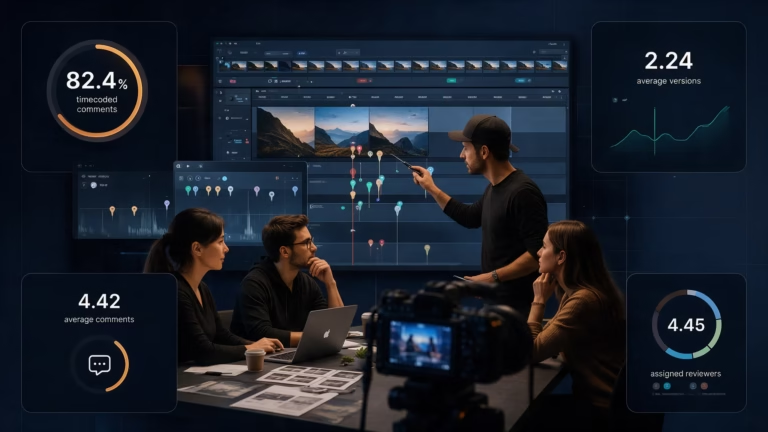
- 82.4% of comments left on Krock.io are pinned to a specific timecode (Krock.io platform data, 2026).
- Each file reviewed on Krock.io has an average of 2.24 uploaded versions (Krock.io platform data, 2026).
- Each file reviewed on Krock.io receives an average of 4.42 comments (Krock.io platform data, 2026).
- Projects on Krock.io have an average of 4.45 assigned reviewers (Krock.io platform data, 2026).
What this means: When reviewers can click a frame, they use it. More than four in five comments point to an exact moment, not a vague “around the middle.” Two of the numbers are conservative. The timecoded share covers every file type, including images and PDFs, which have no timeline, and it counts only comments placed after 0:00, even though many real timecoded notes sit on the opening frame. For video alone, the share is higher. The reviewer count includes only assigned reviewers, not team members who view without an assignment or unregistered guests reviewing through a share link. The real number of people looking at each project is higher. For more on how teams review creative work, see our video review statistics.
Methodology: Aggregated, anonymized activity across all projects on Krock.io from September 2024 to September 2026. Figures cover all file types reviewed on the platform: video, animation, images, PDFs and audio. No individual project, client or file content was accessed. “Versions” = all versions uploaded per file. “Comments” = all comments per file. “Assigned reviewers” = users formally assigned as reviewers on a project. “Timecoded” = comments with a timestamp greater than 0:00. We don’t report approval time, because approval statuses on Krock.io are customizable per team and aren’t consistently dated.
Frequently asked questions
How effective is video marketing?
Marketers rate video as their best-performing content. In HubSpot’s 2026 State of Marketing report, the top three ROI-driving content formats were all video: short-form (48.6%), long-form (28.6%) and live-streaming (25.1%). In B2B, LinkedIn’s 2025 research found marketers with mature video strategies are 2.2x more likely to say their brand is well trusted.
What percentage of businesses use video?
Nearly all of them. 76% of companies make at least one video a month (Wistia, 2026). Among B2B marketers, 78% use video in their programs, and more than half plan to increase video investment in the next year (LinkedIn and Ipsos, 2025). Among social media marketers, 79.56% use Instagram (HubSpot, 2026).
Is video marketing growing in 2026?
Yes, in output and ad spend. U.S. digital video ad spend is projected to pass $80 billion in 2026, up 11% (IAB). Production budgets are flatter: 40% of companies plan to spend more on production and 46% are holding steady (Wistia, 2026).
What type of video has the best ROI?
Short-form video. 48.6% of marketers put it among their top ROI formats, ahead of long-form video at 28.6% and live-streaming at 25.1% (HubSpot, 2026). Among video types, companies rate product videos as the most impactful, followed by webinars (Wistia, 2026).
What is the best platform for B2B video marketing?
LinkedIn. 81% of video teams share videos there, making it B2B’s top video channel, and 67% of teams that cut social clips post them on LinkedIn (Wistia, 2026). YouTube follows at 76%. B2B marketers with mature video strategies are 2.2x more likely to say their brand is well trusted (LinkedIn, 2025).
How does video help SEO?
Video now shows up in AI search as well as standard results. YouTube holds a 29.5% citation share in Google AI Overviews, more than any other domain (BrightEdge, 2025). Google’s video carousel also appears far more often on mobile searches than on desktop (seoClarity, 2024).
How many businesses use AI for video?
More than a third of video teams use AI today, and nearly a quarter more plan to start soon (Wistia, 2026). Adoption is higher among creators: 86% use creative generative AI (Adobe, 2025). On the ad side, Meta’s video generation tools reached a $10 billion revenue run rate in Q4 2025.
What is the ideal video length for marketing?
It depends on the goal. Business videos under one minute have a 65% completion rate, compared with 20% for videos over 20 minutes (Vidyard, 2025). But for software companies, 3- to 30-minute videos perform best, and 31- to 45-minute webinar replays get more than twice the engagement of shorter ones (Wistia, 2026).
Methodology and sources
How we selected these statistics. We included only data published between 2024 and 2026, and preferred 2025 and 2026 data. Every stat links to the organization that ran the survey or owns the data. Where a company reported another firm’s research (for example, Google citing Kantar or Nielsen), both are named. We didn’t round, merge or re-calculate any figure. We left out stats we couldn’t confirm at the original source, stats from other roundup pages, and survey data with no disclosed methodology.
Sources
- Wistia, 2026 State of Video Report (900+ professionals, 13M+ videos, published April 2026). Link
- HubSpot, 2026 State of Marketing Report (1,500+ global marketers). Link
- HubSpot, 2026 Social Media Marketing Report (1,100+ social media marketers). Link
- LinkedIn with Ipsos, 2025 B2B Marketing Benchmark (1,500 senior B2B marketers, six countries, July 2025). Link
- Vidyard, Video in Business Benchmark Report (943,305 videos, January 1 to December 15, 2024; published 2025). Link
- Content Marketing Institute and MarketingProfs, B2B Content and Marketing Trends: Insights for 2026 (1,015 B2B marketers, fielded June to August 2025). Link
- Pew Research Center, Americans’ Social Media Use 2025 (5,022 U.S. adults, February to June 2025). Link
- Pew Research Center, Teens, Social Media and AI Chatbots 2025 (1,458 U.S. teens, September to October 2025). Link
- Pew Research Center, Social Media and News Fact Sheet (survey fielded August 2025). Link
- Nielsen, The Gauge, May 2026 (published July 28, 2026). Link
- Nielsen, The Gauge, December 2025 (published January 20, 2026). Link
- YouTube, CEO Neal Mohan’s 2026 letter (January 21, 2026). Link
- YouTube, 1 billion monthly podcast users (February 26, 2025). Link
- Google, Brandcast 2025 (citing Kantar, Nielsen and Comscore). Link
- IAB with Advertiser Perceptions and Guideline, 2026 Digital Video Ad Spend & Strategy Report (May 5, 2026). Link
- Meta, Q3 2025 earnings call transcript (October 2025). Link
- Meta, Q4 2025 earnings call transcript (January 2026). Link
- BrightEdge, YouTube presence in AI search (May 2024 to September 2025 data, published September 25, 2025). Link
- seoClarity, Video carousel SERP feature research (500M+ queries, July 2023 to June 2024, published August 2024). Link
- TikTok, TikTok World 2025 (June 3, 2025). Link
- Adobe, Creators’ Toolkit Report (16,000 creators in eight countries, published October 2025). Link
- Sprout Social, Q3 2026 Pulse Survey (2,250 consumers, August 11 to 18, 2026, published September 23, 2026). Link
- StreamWork, 2025 Approval Research Study, conducted by Pollfish (500 U.S. marketing and advertising professionals, October 7 to 22, 2025). Link
Cite this page
Krock.io. (2026). Video marketing statistics 2026: 115+ data points for marketers and video teams. Retrieved from https://krock.io/blog/video-marketing-statistics/
Quick attribution:
Source: Krock.io, Video Marketing Statistics 2026 (https://krock.io/blog/video-marketing-statistics/)You’re welcome to use any stat on this page. Please link back here and to the original source.
We update these video marketing statistics every quarter as new reports come out. If your team is reviewing more video versions than ever, you can try Krock.io free.