


To get useful client video feedback, share cuts via a dedicated video review platform (not email), brief clients on exactly what to focus on before they watch, ask three to five specific questions alongside the link, and set a firm deadline. Done consistently, this produces timecoded, frame-accurate notes your editor can act on directly, rather than scattered messages they have to decode.
Last spring, Jamie sent a two-minute brand video to her client for approval. She got back four separate emails, a screenshot of a printed page with handwritten notes, and a Slack message that said “the voiceover sounds a little off around the halfway mark.” No timecode. No indication of which version the client was reviewing. And the phrase “the halfway mark” in a two-minute video puts your editor somewhere in a 30-second window.
Jamie spent more time decoding the feedback than acting on it.
You’ve probably been there. Client video feedback that arrives scattered across channels, referencing vague timestamps, from multiple people who haven’t compared notes, with no indication of priority. It’s one of the most consistent friction points in video production, and it’s almost never the client’s fault.
Clients don’t inherently give bad feedback. They give feedback in whatever form is easiest for them at that moment. Email, Slack, a quick voice note, a screenshotted frame. Your job is to make the useful form the easy form.
This guide covers how to get video feedback from clients that’s timecoded, actionable, and consolidated, the questions that prompt useful notes, and the tools that make the whole process work. For the numbers behind it, see our video feedback statistics. The advice applies to video agencies, animation studios, and any creative team sharing work for client approval.
Why client video feedback is so hard to work with
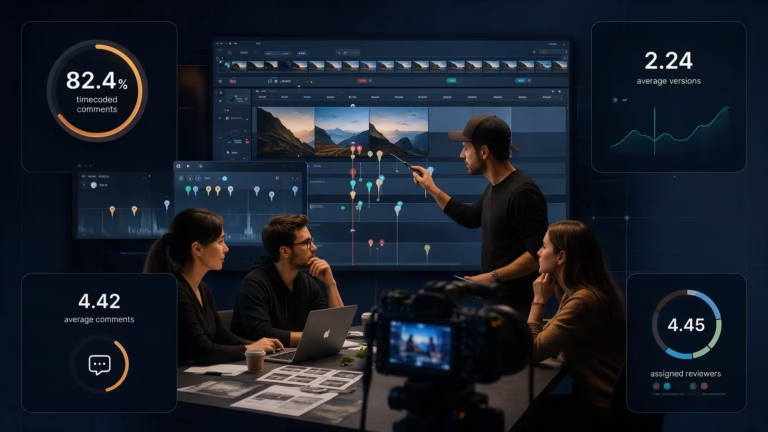
The problem isn’t client willingness. According to MASV’s analysis of video post-production workflows, 60% of video teams go through five or more revision rounds per project, and Wistia’s 2025 State of Video Report found 71% of companies now produce video in-house, meaning more teams handle client feedback directly with no agency buffer. The culprit is almost always the same: feedback collected through channels that weren’t designed for video review.
Here’s what breaks down without a structured client video feedback process:
No frame of reference. When a client watches a video in their email player and then writes notes in a separate message, they have no way to anchor their feedback to a specific moment. “The transition feels abrupt” could mean 12 different transitions depending on the cut.
Multiple reviewers with no consolidation. The marketing director reviews it Monday morning. The CEO watches it Tuesday at 2 p.m. The brand manager sends in notes Wednesday evening. Three separate sets of feedback arrive in three different formats, and they may contradict each other. Nobody in that chain knows what anyone else said.
Vague feedback as the default. When clients aren’t prompted to be specific, they default to subjective impressions. “It feels a bit slow” and “I’d like more energy” are real feelings, not actionable notes. Without a structure that asks for specific moments, general impressions are all you get.
Feedback on the wrong version. If you send a file attachment, clients may review a downloaded copy from two weeks ago. Meanwhile, your team is two cuts ahead. The feedback arrives, nobody mentions which version it’s for, and your editor applies changes to work that already moved on.
No deadline on the review. Open-ended review requests generate open-ended responses. Feedback trickles in over days. Your project timeline slips. Round two starts before round one is complete.
Each of these problems has a fix, and none of them require a difficult conversation with your client.
What good client video feedback actually looks like
Before you can collect better feedback, it helps to know what you’re aiming for. Good client video feedback has four characteristics.
It’s timecoded. The note references a specific moment, ideally a frame range. “At 0:42, the text appears before the music hits” is actionable. “The text timing feels off” is not.
It’s specific. The feedback describes what to change, not just what doesn’t feel right. “The voiceover at 1:15 is too quiet relative to the music” gives your editor a clear action. “The audio balance is wrong” doesn’t.
It’s consolidated. One round of review produces one set of notes from the client side, not a stream of messages across channels over four days. This doesn’t mean one person; it means all reviewers have coordinated their feedback before submitting.
It’s prioritized. Clients who mark feedback as blocking versus nice-to-have give your team information they can use to triage a delivery crunch. Not every note carries the same weight, and good feedback signals that.
| What it looks like | Without a system | With a video review process |
|---|---|---|
| Feedback format | Email, Slack, voice notes, PDFs | Timecoded comments on the actual frame |
| Reviewer coordination | Three people send separate notes | One consolidated round per review stage |
| Version clarity | Unknown which cut the client saw | Client always reviews via a shared link to the current version |
| Specificity | “I don’t love the music” | “At 0:28 the music overpowers the voiceover, can we drop it 3dB?” |
| Response time | Open-ended, no deadline | Defined window per round |
Ready to give clients a review tool that makes this easy? Krock.io’s free plan lets you share video for client review today, no credit card required and no seat fees for reviewers.
How to collect client video feedback: a step-by-step process
The single most effective thing you can do is remove email from the video review loop entirely. Not because email is a bad communication tool, but because it’s a terrible video review tool. It has no timecodes, no version tracking, and no way to resolve individual comments.
Here’s a video review process that works for agencies, studios, and freelancers.
Step 1: Choose a dedicated video feedback tool
You need a tool where the client can leave comments directly on the video, at the specific frame they’re referencing. That’s the baseline. Everything else, version control, comment resolution, approval tracking, is valuable on top of that.
When evaluating video review software for your team, the most important question is whether clients need to create an account. If yes, expect 30-40% of clients to stall at that step. Choose a tool where reviewers can click a link and start watching immediately.
Step 2: Create a review link and share only that
When your cut is ready, upload it to your review platform and share a link. No attachments. No file downloads. The link is the only version the client should be reviewing, which means it’s always the current one.
One sentence in your email is all it takes: “Here’s a link to review the cut. You can leave comments directly on the video at any moment, no login needed.”
Step 3: Brief the client before they watch
This is the step most teams skip, and it’s the highest-leverage one.
Before the client hits play, tell them what you want them to focus on. A three-sentence brief makes a real difference in the quality of feedback you get back:
“We’ve locked the structure and pacing for this round. Focus your notes on messaging clarity, voiceover performance, and whether the call-to-action lands. Visual polish and music selection will be addressed in round two.”
This does two things: it primes the client to give relevant feedback, and it protects you from scope expansion inside a single round.
Step 4: Include specific review questions
Alongside the link, include three to five questions you’d like the client to answer. These don’t need to be long; they just need to be specific.
Good review questions for a first cut:
- Does the opening 15 seconds hook your target audience?
- Is the core message (one sentence here) coming through clearly?
- Does the call-to-action at the end feel natural to the product?
- Is there anything that contradicts your brand guidelines?
This approach consistently produces more useful feedback than “let us know what you think.” When clients have a list of things to evaluate, they evaluate those things specifically.
Step 5: Set a clear deadline
“Let me know your thoughts” is not a deadline. “Feedback requested by Thursday at 5 p.m. ET” is a deadline. Include it in the same message as the review link, and state what happens after it passes: “If we don’t hear back by Thursday, we’ll proceed with the current cut.”
That last sentence sounds firm, but it respects your schedule and it actually tends to generate faster responses.
Consider this approach: when Marcus, a motion design director at a boutique agency in Berlin, started adding that one sentence to every review request, his average feedback turnaround dropped from 4.2 days to 1.8 days. Clients don’t drag their feet on purpose. They just respond to urgency when it’s made explicit.
How to ask clients for feedback that’s actually useful
The quality of feedback you get is directly shaped by how you ask for it. Most teams send the video and say “let us know what you think.” That’s the equivalent of handing someone a book and asking “what did you notice?”
A few practices make a real difference.
Ask about outcomes, not aesthetics. Instead of “what do you think of the edit?” try “does this video make you want to [desired action]?” or “does this match what a customer would expect after visiting your site?” Outcome-focused questions generate more useful responses than aesthetic ones, especially from non-creative clients who struggle to articulate visual preferences.
Name the things you don’t need feedback on. “We’d love notes on the script delivery and the call-to-action. The music and color grade are locked for this round.” Scoping the feedback request tells the client where to direct their attention and stops you from receiving a round of notes on elements you can’t change.
Ask one person to consolidate. If multiple stakeholders are reviewing, ask your main contact to collect internal feedback before submitting to you. “Can you gather the team’s notes and send me one consolidated list by Thursday?” This is a reasonable request and it shifts the consolidation work to the client side, where it belongs.
Follow up on vague notes. When feedback arrives that you can’t act on (“make it feel more premium”), send one short reply: “Helpful, thank you. Can you point to a reference or a specific moment where you’d like to see that change?” Most clients will respond with something usable.
Choosing a video feedback tool for clients
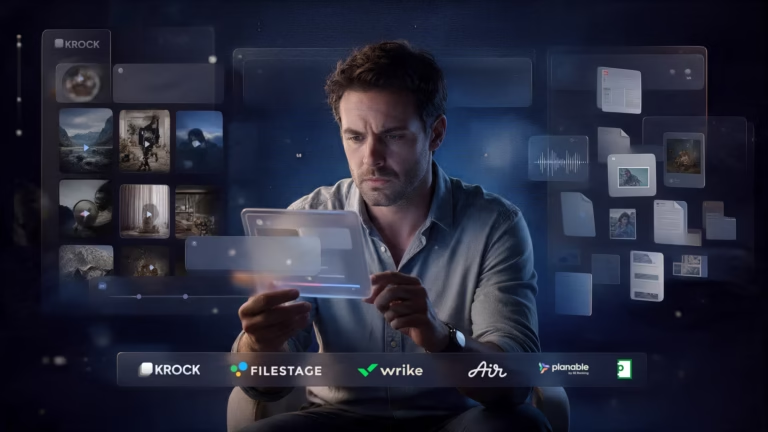
The tool you choose shapes the feedback you get. It also shapes your client approval workflow — because a tool that makes feedback easy to collect makes every downstream step faster too. Here’s a quick rundown of the common approaches and what each one does well or poorly.
Email and file sharing. The most common approach, and the least effective for video review. No timecodes, no frame references, no version tracking. Feedback arrives as text with vague references to moments the client can no longer find because they closed the file. If you’re still collecting client video feedback over email, this is the single biggest change you can make.
Screen recording tools. Sending a Loom or screen record of your feedback session gives clients a way to explain things visually. This is better than text email for some kinds of notes, but it’s one-directional. You can’t thread comments or resolve notes. If you want async video feedback that stays inside your review workflow, Krock.io’s video review comments feature lets clients record and attach video notes directly to the asset, no third-party apps needed.
Generic project management tools. Asana, Notion, Monday.com. These work for task tracking but they don’t understand video. Comments aren’t pinned to timecodes, version history doesn’t carry over, and you’re always one step removed from the actual asset. Clients end up writing “at around the 1:30 mark” in a task card, which puts you back where you started.
Dedicated video review platforms. Purpose-built tools let clients click on the exact frame they’re referencing and leave a note right there. Comments stay anchored to that moment. Versions are tracked, previous comments persist, and the whole review history lives in one place.
When evaluating options, look for: guest review links (no client login required), frame-accurate comments, comment resolution tracking, version management, and support for all your file types, including audio and PDFs for scripts.
Krock.io’s video proofing software checks all of those boxes and covers the full production lifecycle, from storyboard through final delivery. Clients review via link, leave timecoded notes on the exact frame, and your team resolves comments one by one so nothing falls through. Online proofing for creative teams doesn’t have to mean a dozen scattered tools.
Want to see what your client review workflow could look like? Start a free trial and share your next cut in under five minutes, no credit card, no seat fees.
Common mistakes that break your video feedback process
Even with the right tool and the right prompts, a few patterns show up again and again that undermine the whole process.
Sharing multiple versions at once. “Here’s the v4 cut and also the v3 in case you want to compare” sounds helpful but it splits the client’s attention and doubles your feedback surface. Always share one version for review. If comparison matters, use a dedicated comparison feature inside your review platform where both versions are displayed with linked playback.
Letting feedback trickle in. Ana, a producer at a London animation studio, had a standing policy of “keep the review link open until everyone’s weighed in.” One client took 11 days. Her team started on other projects, came back cold, and discovered new notes that conflicted with work already done in the interim. Now she closes review rounds at the stated deadline, sends one reminder the day before, and moves forward regardless. The sky hasn’t fallen once.
Treating all feedback as equal. The CEO’s note about the music choice and the brand manager’s note about a compliance issue are not the same kind of feedback. One is subjective preference, one is potentially a problem. Build a simple priority signal into your review brief: “Please mark anything that must change with an asterisk, and anything that would be nice to change without one.” This tiny convention saves significant time in triage.
Not acknowledging received feedback. When clients submit notes and hear nothing for two days, they often resend the same notes thinking you didn’t get them. A one-line acknowledgment, “Got your notes, we’re on it, we’ll have a new cut to you by [date],” eliminates that loop entirely and makes clients feel heard.
Once you have feedback collected and organized, the next challenge is working through revision rounds without scope creep or version confusion. Our guide on how to manage client video revisions covers that side in detail. For a full framework from kickoff to final sign-off, the review and approval process guide walks through every checkpoint.
Pulling it all together
Collecting client video feedback that your team can actually act on comes down to three things: the right tool, the right ask, and the right structure.
The right tool means a dedicated video review platform where clients leave timecoded notes on the actual frame, not email threads. The right ask means briefing clients on what you want feedback on, including specific questions, and naming what’s off-limits. The right structure means one consolidated round, one deadline, and one version for review.
None of this requires new software skills from your clients. It requires a 10-minute setup on your side, a short briefing paragraph in your review email, and a deadline that you hold to.
The reward is feedback that takes your editor 45 minutes to work through instead of half a day, revision rounds that close when you say they close, and clients who trust the process because it’s clear.
Start building your client video feedback process in Krock.io today. The free plan covers two projects with unlimited reviewers, no login required for clients, and timecoded comments from the first upload.