

Searching for the best Premiere Pro alternative? You have more options than ever — and most of them are considerably cheaper than Adobe’s subscription model.
Adobe Creative Cloud Standard — which bundles Premiere Pro with After Effects, Audition, and 20+ other apps — costs $54.99/month per seat ($659.88/year). For a five-person editing team, that’s $3,300 before storage overages, third-party plugin licenses, or the Frame.io subscription your clients now expect as part of the review workflow.
That figure tends to clarify the decision pretty quickly.
If you’re weighing your options, you’re not alone. DaVinci Resolve passed one billion downloads in 2024. Final Cut Pro’s one-time pricing model is bringing editors back to Mac. A growing number of agencies are rethinking the entire Adobe stack, not just the editing software.
This guide covers the best Premiere Pro alternatives available in 2026, from professional free tools to affordable one-time purchases to specialized platforms for specific workflows. We’ll also cover something most alternatives guides skip entirely: what happens to your client review and approval workflow when you leave Adobe’s ecosystem. That’s where a lot of teams get stuck.
Why editors are looking for Premiere Pro alternatives
Premiere Pro is a genuinely capable tool. It handles almost every format, plays well with After Effects and Audition, and runs on both Mac and Windows. None of the alternatives in this list do everything Premiere does. That’s worth acknowledging.
But three things keep driving editors toward alternatives:
The subscription never ends. At $22.99/month for Premiere Pro alone — or $54.99/month for Creative Cloud Standard with the full suite — you’re paying indefinitely. A freelancer who switched to DaVinci Resolve in 2021 has already saved over $1,300 compared to a Premiere Pro subscription. The tool is free. The savings compound every year.
Performance has been uneven. Premiere’s GPU utilization and real-time playback have frustrated editors on heavy effects timelines for years. DaVinci Resolve, which Blackmagic has been aggressively developing, now outperforms Premiere on many hardware configurations, particularly Apple Silicon Macs and high-end GPU setups.
The Adobe ecosystem is designed for lock-in. Premiere’s deepest advantages come from how it connects to After Effects, Audition, and Frame.io. Useful integrations, but they also make leaving feel more disruptive than it needs to be. Many editors who’ve made the switch report the transition was easier than they expected.
The top Premiere Pro alternatives at a glance
| Tool | Price | Platform | Best For | Free Option |
|---|---|---|---|---|
| DaVinci Resolve | Free / $295 Studio (one-time) | Mac, Windows, Linux | Professional editing + color | Yes |
| Final Cut Pro | $299.99 (one-time) | Mac only | Fast Apple Silicon editing | 90-day trial |
| CapCut | Free / paid tiers | Mac, Windows, Mobile | Social content, creators | Yes |
| Vegas Pro | $399 (perpetual) | Windows | Windows-native editing | No |
| Filmora | $61.99/year or $89.99 lifetime | Mac, Windows | Intermediate creators | Limited |
| Avid Media Composer | $259.99/year Standard ($539.99/year Ultimate) | Mac, Windows | Broadcast, film, enterprise | Limited |
| Kdenlive | Free | Mac, Windows, Linux | Open-source indie editing | Yes (fully free) |
DaVinci Resolve, best overall Premiere Pro alternative
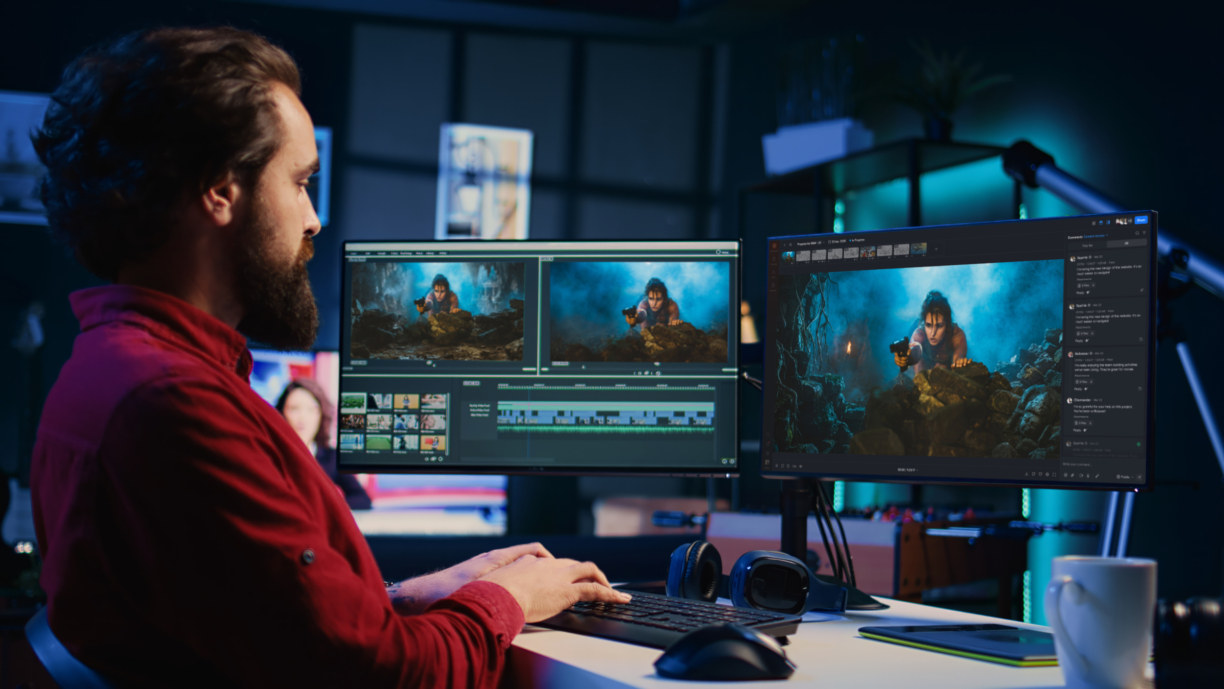
DaVinci Resolve is the clearest recommendation for most editors leaving Premiere Pro. The free version isn’t a stripped-down demo, it’s a full professional non-linear editor used on major film and television productions. (If you want a broader look at free tools beyond this list, our best free video editing software guide covers 11 options across every skill level.) The upgrade to DaVinci Resolve Studio costs $295 as a one-time purchase and adds AI noise reduction, multi-user collaboration, and advanced stereoscopic tools. Krock.io’s DaVinci Resolve integration lets you send cuts directly from Resolve for client review without leaving your editing environment.
James, a freelance commercial editor in Chicago, made the switch in January 2024 after Adobe raised prices for the third time. He’d been paying $20.99/month for Premiere Pro alone. Within two months on Resolve, he’d recouped the Studio license cost.
“The color page alone makes it worth it,” he said. “I used to do color passes in Premiere knowing they were mediocre. Now I don’t outsource grading.”
Resolve’s color page is the professional standard for film finishing: DaVinci Resolve was used to grade major productions including Top Gun: Maverick, The Batman, and Avengers: Endgame, and Blackmagic Design reports it is used on the majority of Hollywood releases. The editing page handles everything Premiere does, including multicam, mixed formats, and complex timelines. The Fairlight audio page replaces Audition for most use cases.
What you give up: After Effects integration via Dynamic Link. Resolve’s Fusion compositing is powerful but runs on a node-based paradigm that requires real learning time. If motion graphics work is central to your workflow, plan for that transition.
Best for: Professional video editors, agencies, production companies, and anyone who wants broadcast-quality tools without a subscription.
Final Cut Pro, best for Mac-based teams
Final Cut Pro’s $299.99 one-time purchase from the Mac App Store becomes more attractive every year Premiere Pro’s subscription continues. Two years in, you’ve already broken even against a single-app Premiere subscription. Five years in, you’ve spent $300 total instead of $1,380 on Premiere Pro.
Apple Silicon gives Final Cut Pro a measurable hardware edge: M-series chips include a dedicated media engine that hardware-accelerates ProRes encoding and decoding, a capability no competitor can use on the same silicon. On an M3 MacBook Pro, Final Cut renders and exports faster than any other editing tool available. For teams doing high-volume content production, episodes, social cuts, broadcast segments, that speed difference is real time saved.
The magnetic timeline is an adjustment. Editors who’ve spent years in track-based timelines often need two to four weeks before FCP’s behavior feels natural. Those who push through generally find they edit faster. Those who don’t often switch back.
What you give up: Windows compatibility (Final Cut Pro is Mac-only), the After Effects pipeline, and some third-party plugin ecosystem depth. Motion, FCP’s bundled graphics tool, is genuinely capable but smaller than the After Effects template market.
Best for: Mac-based freelancers, boutique agencies, and high-volume content teams who want maximum export speed and one-time pricing.
CapCut, best for social content and creators
CapCut has evolved from a TikTok-adjacent mobile app into a credible desktop editing platform. For teams producing primarily short-form social content, Reels, Shorts, TikTok, YouTube content under 15 minutes, CapCut’s speed-to-output ratio is hard to beat.
The AI features are genuinely integrated rather than bolted on: auto-captions in over 20 languages, background removal, AI voiceover, and text-to-video tools that speed up repetitive production tasks. The template library is massive and kept current with platform trends.
What you give up: CapCut is not a professional post-production tool. Color correction is functional, not deep. Audio handling is basic. Export options are limited compared to Premiere. For broadcast, commercial, or film work, it’s not a consideration.
A note on data: CapCut is owned by ByteDance (TikTok’s parent company). Teams handling sensitive client footage should review their data handling policies before using CapCut for commercial projects.
Best for: Social media managers, content creators, brands producing high-volume short-form content.
Vegas Pro, best Premiere Pro alternative for Windows editors
Vegas Pro has been a professional Windows editing tool since 1999. Its perpetual license model ($399) makes it one of the few Windows-native editors that doesn’t require ongoing subscription spending.
The audio mixing workflow is a genuine strength, Vegas integrates audio tools more naturally than Premiere, which requires Audition for serious audio work. For event videographers, documentary editors, and teams doing heavy music-driven projects, that integration matters.
What you give up: The ecosystem is smaller. Fewer tutorials, smaller community, less active third-party development. Vegas has not kept pace with DaVinci Resolve or Premiere on AI-powered editing features.
Best for: Windows-based editors and small studios who want professional tools without subscription pricing and handle significant audio work.
Filmora, best for teams new to professional editing
Filmora sits between consumer apps and professional tools, and that’s exactly where it should be. The learning curve is measured in days rather than weeks. The UI is clean and logically organized.
At $89.99 as a lifetime license (or $61.99/year), it’s accessible for individual creators and small marketing teams who need to produce professional-looking video without a dedicated editor on staff.
What you give up: Filmora won’t handle complex broadcast deliverables, deep color grading, or advanced VFX work. It’s a content tool, not a post-production platform.
Best for: Marketing teams, small businesses, and content creators who need good results without deep technical training.
Avid Media Composer, best for broadcast and enterprise
Avid Media Composer is the broadcast standard for a reason. Major television networks, film productions, and post houses depend on Media Composer for its shared storage architecture, bin-locking for multi-editor collaboration, and reliable handling of broadcast specs and deliverable formats.
If your work regularly touches networks or large post facilities, Avid compatibility often isn’t optional, it’s a technical requirement of the pipeline.
What you give up: A modern UI and a gentle learning curve. Media Composer’s interface shows its age, and the pricing (subscription or seat licensing) isn’t significantly cheaper than Adobe’s.
Best for: Broadcast editors, large post-production facilities, and teams that need to deliver to network specifications or integrate into Avid-based facilities.
Kdenlive, best free open-source option
Kdenlive is a free, cross-platform (Mac, Windows, Linux) non-linear editor maintained by the KDE community. It won’t match DaVinci Resolve’s depth, but for indie filmmakers, Linux users, or teams committed to open-source tools, it’s the credible free option.
Best for: Independent filmmakers, Linux users, and creators committed to open-source software.
The piece most Premiere Pro alternatives guides skip: client review and collaboration
Here’s a situation that plays out regularly at agencies and studios switching off Adobe.
A three-editor production company decides to move to DaVinci Resolve. The transition goes smoothly, editors love the color page, the free tier handles everything they need. Two months in, they’re happier with their editing tool than they’ve been in years.
Then a campaign delivery lands. Four video cuts, client stakeholders at three different companies, 48-hour turnaround for approvals.
Previously, this happened in Frame.io, which was bundled into their Adobe subscription. They dropped Frame.io when they dropped the subscription. The client team ends up sending feedback over email. Then a Slack thread. Then a voice note.
Then an email referencing the voice note.
By the time the editor sits down to cut revision round two, she’s not sure which of the three email threads contains the final approved feedback. The client swears they mentioned the logo timing in the “first email.” The producer can’t find it.
The editing tool wasn’t the problem. The review and approval workflow was.
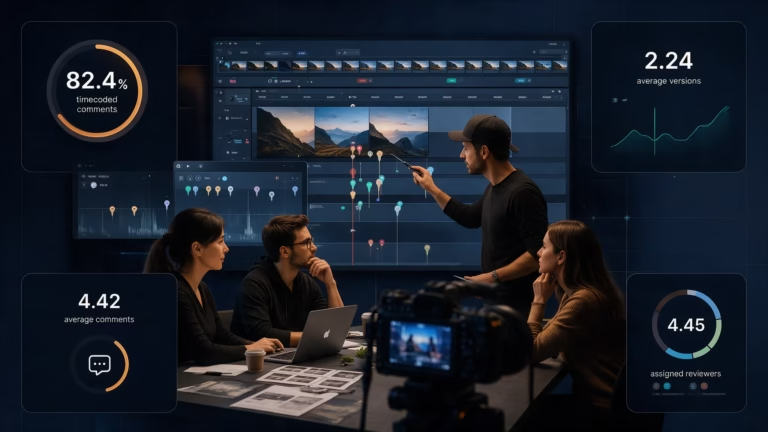
This is the gap that dedicated video review platforms fill. Krock.io isn’t a video editor, it’s the collaboration layer that sits above your editing tool. Upload your cut, and clients leave frame-accurate comments at the exact timestamp they mean.
Internal team notes stay separate from client-facing feedback. Approval status is tracked automatically, not via a follow-up email thread.
Krock.io integrates directly with DaVinci Resolve Studio, Apple Final Cut Pro, and Adobe Premiere Pro via the Adobe Creative Cloud plugin. So whether you stay on Premiere or move to Resolve or FCP, the client review workflow is the same. Your clients don’t need an account, they click a link and leave comments.
The pricing model is also structured differently from Frame.io: Krock.io charges per creator, not per reviewer. Invite your entire client team to review a cut without adding per-seat costs. For agencies that work with large client organizations, the pricing difference compared to Frame.io is significant.
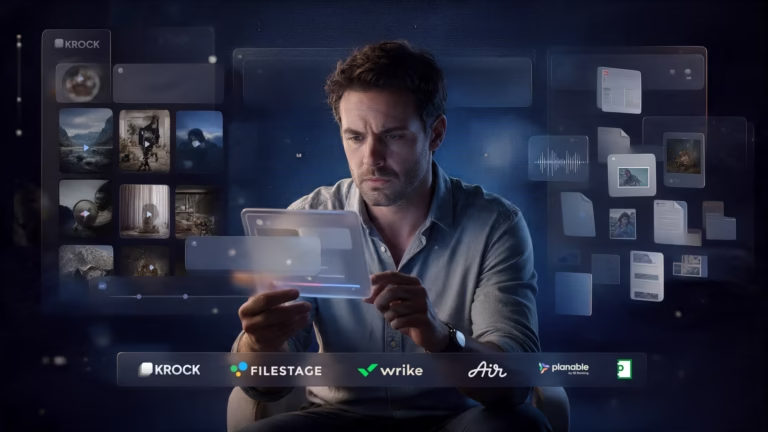
One more angle worth considering: if you’re switching away from Premiere Pro partly to get out of Adobe’s ecosystem, that includes the bundled Frame.io access. Replacing Frame.io with Krock.io as your standalone review platform, whether you stay on Premiere for editing or switch to Resolve, gives you the collaboration workflow without the Adobe dependency. See how the top Frame.io alternatives compare if you’re evaluating the full review workflow alongside your editing tool decision.
See how Krock.io’s video review software works with any editing tool →
How to choose the right Premiere Pro alternative
Four questions narrow the options quickly:
What platform are you on?
Mac users have the clearest options: DaVinci Resolve (free, professional, cross-platform) or Final Cut Pro ($299, Mac-only, fastest on Apple Silicon). Windows users: DaVinci Resolve or Vegas Pro. Linux: DaVinci Resolve or Kdenlive.
What’s your After Effects dependency?
If motion graphics and VFX compositing are central to your work, the After Effects Dynamic Link workflow is hard to directly replace. DaVinci Resolve’s Fusion is capable but uses a different compositing paradigm. FCP uses Motion. Editors with significant AE work often stay in Premiere and instead look to cut costs elsewhere in their stack, including replacing Frame.io with a cheaper, more capable review platform.
What type of content are you producing?
Broadcast and film work: DaVinci Resolve or Avid. Social and creator content: CapCut or FCP. Event and corporate video on Windows: Vegas Pro. General commercial and agency work: DaVinci Resolve or FCP.
What happens to client review when you switch?
Most tools on this list don’t include a built-in client collaboration workflow. DaVinci Resolve Studio has basic collaboration features for multi-editor teams, but not the client-facing review and approval workflow most agencies need. Plan your review platform decision as part of the editing tool switch, not after.
A pricing comparison across video review tools can help model the cost of your full production stack, editor, review platform, storage, across different tool combinations.
Conclusion
For most video editors leaving Premiere Pro, DaVinci Resolve is the answer: professional-grade, genuinely free, and available on every platform. Final Cut Pro is the better choice for Mac-based teams that prioritize speed and want a one-time pricing model. CapCut works for social content at scale. Vegas Pro serves Windows-based studios that want a perpetual license. Avid Media Composer is the broadcast standard where it matters.
The editing tool is the easier decision. The harder one, and the more operationally important one, is your client review and approval workflow. Whatever editor you land on, creative teams that centralize feedback, track approval status, and keep internal notes separate from client-facing comments move faster through revision cycles.
If you’re reassessing your Adobe subscription and want to see what a modern video review workflow looks like outside the Adobe ecosystem, Krock.io offers a free plan with unlimited reviewers, frame-accurate commenting, and integrations with Premiere Pro, DaVinci Resolve, and Final Cut Pro.