

Successful collaborating with influencers on video content comes down to five stages: define your goal and metrics, find creators whose audience matches your buyers, write a brief that gives direction without killing creativity, manage the review and approval process without endless back-and-forth, then measure and repurpose what works.
Most brand-influencer video collaborations fall apart not in the strategy phase but in execution. The brief gets sent over email, the creator submits a draft via Google Drive link, four stakeholders leave feedback in three different places, and the influencer revises the video twice based on contradictory notes. By the time the content is approved, the campaign window has passed or the creator has moved on to another brand.
The brands consistently getting high-performing influencer video content have the same thing in common: a clear process from brief to approval. This guide covers exactly that.
Why influencer video content outperforms brand-produced video
Influencer video consistently outperforms brand-produced video in cost-per-engagement and audience trust. According to the Influencer Marketing Benchmark Report 2026, brands earn an average of $5.78 for every $1 spent on influencer marketing. The global influencer marketing market reached approximately $32 billion in 2025, up 36% year over year.
The reason is straightforward: audiences have tuned out polished brand advertising. Creator content feels like a recommendation from someone they already trust. That trust gap is what brands are paying for when they work with influencers.
For video specifically, the performance advantage is significant. Sprout Social’s 2026 influencer data reports that 70% of viewers bought a brand’s product after seeing it featured on YouTube, and that YouTube influencers see engagement rates of approximately 49%. In B2B, 55% of marketers now work with influencers and creators, according to LinkedIn research covered in our B2B video marketing statistics. Those numbers don’t exist for most brand-owned channels.
What type of influencer is right for video collaboration
Not all influencers produce high-quality video content, and not all audiences are right for every brand. Before reaching out, match the creator tier to your campaign goal.
| Creator tier | Follower range | Best use case | Typical cost per video |
|---|---|---|---|
| Nano | 1,000–10,000 | Authentic community engagement, niche audiences | $50–$300 |
| Micro | 10,000–100,000 | High engagement, specific verticals | $300–$2,000 |
| Macro | 100,000–1M | Brand awareness at scale | $2,000–$20,000 |
| Mega | 1M+ | Mass reach, tentpole campaigns | $20,000+ |
Micro-influencers consistently outperform macro-influencers on engagement-per-follower and cost-per-conversion. For most brands running product or campaign video content, micro-influencers with 20,000–80,000 followers in a specific vertical deliver the best return.
More important than follower count is content quality and audience fit. Watch at least five recent videos before outreach. Ask: does this creator’s production quality match what our brand needs? Does their audience actually buy the category we operate in?
How to find the right creators for video collaboration
Start with your existing community. Check who’s already tagging your brand, mentioning your products, or creating unprompted content in your category. Warm outreach to existing fans converts at far higher rates than cold DMs.
For discovery at scale, tools like Modash, Upfluence, and CreatorIQ let you filter by niche, engagement rate, audience demographics, and content format. For YouTube specifically, Social Blade gives you channel growth trajectory — a creator growing consistently at 5–10% per month is a better long-term partner than one who peaked 18 months ago.
Three filters to apply to any shortlist:
- Engagement rate over follower count. A channel with 30,000 followers and 8% engagement reaches a more actionable audience than one with 200,000 followers and 0.4% engagement.
- Recent video performance. Check view counts on the last 10 videos, not the channel’s most popular videos ever. Channels burn out, niches shift.
- Alignment on values, not just category. The creator’s public positions and content history will reflect on your brand. Check beyond the last few posts.
How to brief influencers without killing their creativity
The brief is where most influencer video campaigns go wrong. Either the brand sends a 12-page document specifying every shot and line of dialogue (and kills the creator’s voice), or they send a one-line email with no context and get content that misses the point entirely.
77% of content creators say they’re more likely to work long-term with brands that grant them creative freedom. The brief’s job is to give direction on strategy, not to script the content.
A strong influencer video brief contains exactly six things:
- Campaign goal. What is this video supposed to accomplish? Drive sign-ups, build awareness, push a specific product page? Be specific about one primary goal.
- Key message. The one thing viewers should understand or feel after watching. Not three things — one.
- Required inclusions. Product name, any mandatory legal disclosures, campaign hashtag, CTA link. Keep this list short.
- What to avoid. Brand safety guidelines, competitor mentions, topics off-limits given current brand positioning.
- Reference content. Link to 2–3 examples of content that captures the right tone. Visual references communicate more than paragraphs of description.
- Deliverables and timeline. Format, duration, first draft due date, and approval deadline.
Use an AI storyboard maker to rough out a visual narrative before sending the brief — especially for longer-form or narrative video content. When the creator can see what the brand is imagining, the first draft lands closer to what was intended and revision rounds drop.

Managing the review and approval process
This is the stage where most influencer video collaborations lose time and goodwill.
The typical flow looks like this: creator submits a draft via email attachment or DM link. Brand stakeholders watch it at different times, leave feedback in different places (reply-all email, Slack DM, voice note), and the creator receives a confused summary of contradictory notes. This repeats two or three times before anyone is satisfied. The creator, frustrated by unclear feedback, does what’s minimally necessary to close the loop. The brand gets mediocre content.
A better process has three rules:
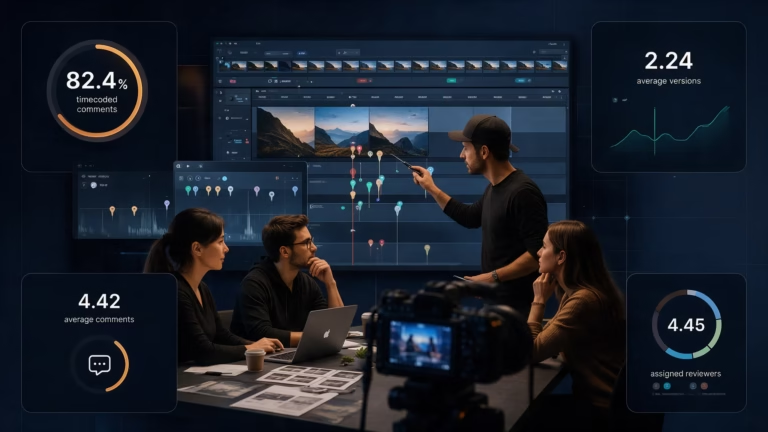
Centralize review. All feedback on a video draft should happen in one place, tied to the specific timestamp or frame being referenced. Video proofing tools replace the scattered email thread with a single shared review link where every stakeholder leaves their annotations on the same version. The creator sees organized, timestamped feedback instead of a collated summary.
Limit feedback rounds in the contract. Specify in the collaboration agreement the number of revision rounds included (typically two). Unlimited revisions invite scope creep and signal to the creator that no amount of work will be good enough.
Separate internal and creator-facing feedback. Your internal team will have discussions that shouldn’t go to the creator — debates about brand direction, stakeholder disagreements, legal review notes. Online proofing for creative teams keeps internal annotations separate from the feedback that’s shared externally, so creators only see what’s relevant and actionable.
Consider what happened with a mid-sized lifestyle brand running a campaign with eight micro-influencers simultaneously. Before implementing a centralized review tool, each creator’s draft circulated through a different email chain. Three creators received duplicate revision requests, two received contradictory feedback from different stakeholders, and one creator ghosted entirely after receiving a 2,000-word feedback document from five different people. The campaign launched three weeks late. After centralizing review, the same volume of campaigns cleared approval in under 48 hours per asset.
Repurposing and distributing influencer video content
Licensing rights are often overlooked at the brief stage and become expensive later. Clarify upfront whether you’re licensing content for paid distribution, how long the license runs, and which platforms it covers.
With rights secured, influencer video content is one of the most versatile marketing assets a brand can own. A 60-second YouTube collaboration can produce:
- A 15-second paid social ad (Instagram, TikTok)
- A GIF or short clip for email campaigns
- A website testimonial or product page embed
- A B-roll cut for a longer brand video
The value of influencer content multiplies significantly with repurposing. Plan for it in advance. When you brief the creator, ask them to capture B-roll or outtakes that could be useful independently. A creator who knows this upfront will shoot with repurposing in mind.
Measuring what actually worked
Set up measurement before the campaign launches, not after. The metrics that matter depend on the campaign goal set in the brief.
For awareness campaigns: reach, impressions, share of voice, brand search lift.
For conversion campaigns: clicks, promo code redemptions, affiliate attribution, cost-per-acquisition.
For community building: saves, comments, replies, followers added from the creator’s audience.
Don’t evaluate performance at the 24-hour mark. For YouTube, a video can continue accumulating views for 6–12 months. Define your attribution window (usually 30–90 days for influencer campaigns) and check at consistent intervals. Comparing performance against benchmarks — average CPM for your industry, typical conversion rate for your funnel — gives more signal than comparing creator against creator.
Track what made top-performing pieces work. Was it the creator’s delivery? The hook they used? The product integration method? Feed those learnings into the next brief.
Understanding what drives viral video marketing campaigns matters here — the same principles that help organic video break through (strong hooks, emotional resonance, social currency) apply to influencer content that earns additional reach.
Building long-term creator relationships
One-off activations rarely produce compound returns. Brands that treat influencer video collaboration as a channel rather than a campaign consistently see better results over time.
Long-term creator relationships work because the creator learns your brand, your product, and your audience’s language. Their content becomes more authentic, not less, as they become a genuine user or advocate. 71% of influencers offer reduced rates for long-term brand partnerships, which means the economics improve alongside the quality.
Structure long-term relationships with clear deliverables per quarter, a simple performance review at 90 days, and renewal terms that reward content performance. Give creators early access to new products and treat them as a stakeholder in campaign performance — not just a vendor delivering a SKU.
Conclusion
Collaborating with influencers on video content is one of the highest-ROI channels available to marketing teams in 2026, but the return depends almost entirely on execution: the quality of the brief, the efficiency of the review process, and how well you capture and redistribute what performs.
The brands getting the most out of influencer video aren’t necessarily spending more. They’re briefing more clearly, reviewing more efficiently, and treating creators as long-term partners rather than one-time vendors.
Get the brief right. Get the review process right. Everything else follows.
Ready to cut review time on your next influencer campaign? Try Krock.io free — unlimited reviewers, no credit card required.