


91% of businesses now use video as a marketing tool in 2026, and 92% of video marketers plan to maintain or increase their video budgets. Those aren’t leading indicators anymore — they’re proof that video content marketing has become the baseline expectation for brands competing for audience attention.
The question isn’t whether to invest in video. It’s how to invest in it well — which formats drive real return, which metrics actually matter, and how to build a production workflow that lets your team create more without burning out on revision cycles.
Here’s the data on what video actually delivers, and a practical guide to making it work.
The 2026 case for video content marketing
The numbers from Wyzowl’s 2026 video marketing report are clear:
- 82% of marketers say video marketing has given them good ROI
- 93% say video has helped increase user understanding of their product or service
- 93% say video has helped them increase brand awareness
- 85% say video has helped them generate leads
- 83% say video has directly increased sales
- 85% of consumers have been convinced to buy a product after watching a video
That last number is the one that matters most for ROI conversations. Content that moves people from consideration to purchase is the hardest thing to produce in marketing, and video does it consistently.
For comparison: email marketing delivers strong ROI but drives action primarily from people already in the funnel. Video reaches people earlier, builds the trust that email then converts, and works at every stage of the buyer journey simultaneously.
Which video formats drive the highest return
Not all video investment delivers equal ROI. Understanding where to allocate production budget by format is the difference between video marketing that compounds and video marketing that burns money.
| Format | ROI rank (2026) | Best use case | Average production cost |
|---|---|---|---|
| Short-form video (<60 sec) | #1 | Awareness, social, product demos | $500–$3,000 |
| Long-form video (5–20 min) | #2 | Education, thought leadership, tutorials | $3,000–$15,000 |
| Live streaming | #3 | Community, launches, events | $1,000–$8,000 |
| Webinars | #4 | Lead generation, B2B | $500–$3,000 |
| Video testimonials | #5 | Conversion, social proof | $200–$2,000 |
Short-form video has ranked as the highest-ROI content format for three consecutive years, according to DemandSage’s 2026 marketing data. Videos under 60 seconds generate 2.5× more engagement per impression than any other content type. For brands just starting to build a video content program, short-form is where to start.
Long-form video — tutorials, case studies, deep-dive educational content — builds the kind of brand authority that short-form can’t. A 12-minute tutorial that genuinely teaches something earns trust, bookmark saves, and return viewers in ways a 45-second reel doesn’t.
The most effective video content programs use both: short-form to reach new audiences and build brand recognition, long-form to convert and retain.
The seven reasons video content marketing outperforms other formats
1. Video builds trust faster than text
Reading about a product feature and watching it demonstrated in context produce different levels of conviction. Video shows rather than tells — the product in use, the team behind the brand, the customer whose problem was solved. That demonstrable authenticity is what moves buyers.
93% of marketers report that video has increased user understanding of their products, and understanding precedes trust. Audiences who genuinely understand what you do are more likely to buy and less likely to churn.
2. Video is consumed everywhere in the buyer journey
A blog post reaches people in research mode. A video reaches people wherever they are — on their phone, watching a playlist, scrolling social. That’s not a trivial advantage. Video is the format audiences choose voluntarily; text is often the format they accept reluctantly.
The shift is structural. Platforms have restructured their algorithms to prioritize video: Instagram, LinkedIn, YouTube, and TikTok all favor video content in organic distribution. Text content that would have reached thousands five years ago now reaches hundreds. The same investment in video reaches more people.
3. Video drives search traffic and boosts SEO
Video content improves dwell time — the amount of time visitors spend on a page — which is one of the strongest signals search engines use to evaluate content quality. A page with an embedded video explaining a product feature keeps visitors engaged longer than text alone.
YouTube is the second-largest search engine in the world. Video content properly optimized for YouTube — with descriptive titles, transcripts, and clear keyword targeting — reaches search audiences who would never find written content. For explainer content, tutorial content, and product demonstration content, YouTube distribution compounds organic reach over years.
4. Video content generates more shares and organic reach
Video generates significantly more social shares than static image or text posts across every major platform. For brands trying to extend reach without paid amplification, video is the highest-leverage format available.
The mechanics behind sharing are straightforward: video is easier to pass along (it requires no reading), more likely to generate emotional response (which is the primary driver of sharing), and more likely to be recommended by platform algorithms. Understanding what makes content worth sharing is the foundation of viral video marketing campaigns — and those same principles apply to any brand trying to earn organic distribution.
5. Video builds brand personality more effectively than text
“What does this brand feel like?” is a question text struggles to answer and video answers immediately. Tone of voice, visual identity, energy, pace, people — all of these come through in video in seconds in ways that take paragraphs to convey in writing.
For new brands and brands trying to shift perception, video is the fastest way to establish a distinct personality in the audience’s mind. For established brands, consistent video content maintains that personality in an attention-fragmented media environment.
6. Video supports every stage of the marketing funnel
Most content formats are optimized for one funnel stage. Video works at all of them:
- Awareness: Social video, branded content, YouTube pre-rolls
- Consideration: Product demo videos, comparison content, tutorials
- Decision: Customer testimonials, case study videos, walkthrough demos
- Retention: Onboarding videos, feature education, community content
A properly structured video content program can address the full funnel with a single format — reducing the number of content types you need to produce and create while maintaining reach at every stage.
7. Video production is more accessible than ever
AI-powered editing tools have reduced the median video production cost from $4,200 to $2,500 per finished minute between 2023 and 2026. Script writing, voiceover, editing automation, captioning, and translation tools have all dropped in cost and improved in quality.
The barrier to entry for professional-quality video content has fallen significantly. Teams that couldn’t justify video production three years ago can now produce consistently on reasonable budgets.
The production challenge: scaling without chaos
The investment case for video is clear. The challenge most teams hit isn’t “why video?” — it’s “how do we actually produce more video without the review and approval process eating all the time we save in production?”
The review workflow is where video production most commonly breaks down. A script gets approved by one stakeholder and revised by another. A final cut gets sent via email, receives three rounds of conflicting feedback across different threads, and ships in version 6 when version 4 was correct.
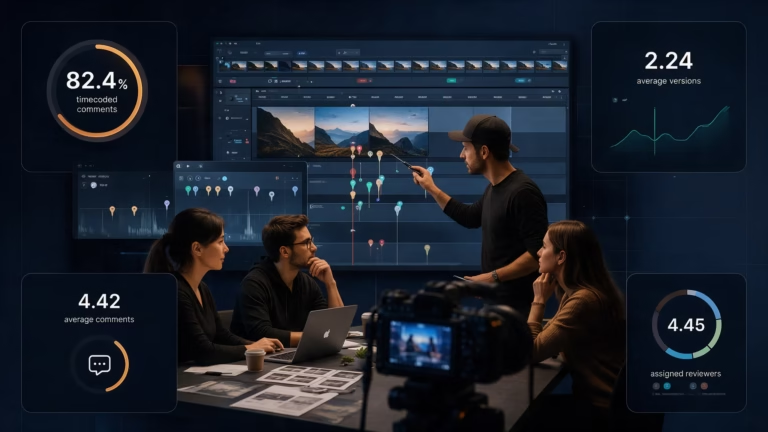
Online proofing for creative teams addresses this directly: one shared review link, timestamped frame-accurate comments from all stakeholders, one consolidated feedback view for the editor. No email threads, no version confusion.
For teams planning video production before it starts, an AI storyboard maker aligns the creative team on the visual sequence before production begins — preventing the expensive reshoots that happen when the brief and the execution diverge.
And once video is in review, video proofing keeps every version, every comment, and every approval in one traceable place — so you always know which cut is approved and which is in progress.
Measuring video content marketing ROI
Track what’s actually connected to business outcomes, not just engagement vanity metrics.
For awareness campaigns: Reach, brand search lift, share of voice, new audience growth.
For consideration campaigns: Watch time, completion rate (videos completed to 75%+ indicate genuine engagement), click-through to product pages.
For conversion campaigns: Form fills, trial sign-ups, promo code redemptions, direct attribution by platform.
For retention campaigns: Feature adoption rates post-onboarding video, support ticket volume reduction, NPS score correlation.
Set measurement baselines before launching any significant video content investment, and review at 30-day intervals rather than daily. Video content often has a delayed performance curve — especially on YouTube, where discoverability builds over weeks and months rather than hours.
Conclusion
The case for video content marketing in 2026 isn’t theoretical. 91% of businesses are already using it, 82% report strong ROI, and the trend is accelerating as production costs fall and platform algorithms favor video distribution. The brands not investing are ceding ground to the ones that are.
The return on video depends not just on how much you invest but on how efficiently you can create, review, and ship content. Production quality matters. Review process quality matters just as much.
Ready to speed up your video review and approval workflow? Try Krock.io free — unlimited reviewers, frame-accurate annotations, no credit card required.