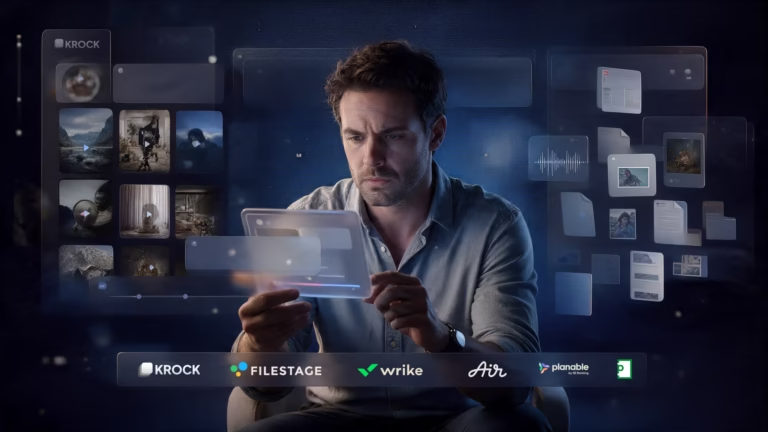



Most agencies don’t have a tools problem. They have a tool sprawl problem.
The average creative agency runs 8 to 12 separate tools at once: one for design, one for video review, another for project management, a different one for client communication, and yet another for CRM. None of them talk to each other well. Half of them nobody uses correctly. And the moment you add a new client or hire two more people, the whole thing creaks.
This guide cuts through that. We’ve mapped out the best software for creative agencies across five core categories: proofing and review, design, project management, communication, and client management. For each category, we tell you which tool wins, who it’s best for, what it costs, and when a cheaper alternative is just as good.
We’ve also included a section at the end on building the right stack by agency size, because the tools that work for a 3-person motion studio are not the same tools that work for a 40-person ad agency.
Jump to the comparison table to find your category, or read through for the full breakdown.
Quick Comparison: Best Creative Agency Software by Category
| Category | Best Pick | Best For | Starting Price | Free Plan |
|---|---|---|---|---|
| Video Review & Proofing | Krock.io | Video and animation teams | $10/user/mo | Yes |
| Document Proofing | Ziflow | Enterprise document review | $199/mo | Yes |
| Design & Illustration | Figma | UI/UX and collaborative design | $16/user/mo | Yes |
| Creative Production | Adobe Creative Cloud | Full-service agencies | $99/user/mo Business Plan |
No |
| Project Management | Monday.com | Mid-size agencies | $12/user/mo | Yes |
| Project Management (fast-moving) | Linear | Tech-forward agencies | $10/user/mo | Yes |
| Internal Comms | Slack | All team sizes | $8.75/user/mo | Yes |
| Client Management | HubSpot CRM | Growth-focused agencies | $0 (CRM) | Yes |
| Client Reporting | Agency Analytics | Digital/SEO agencies | $59/5 clients/mo | No |
This table targets the featured snippet. But the real answer depends on your agency type and size, which is why the rest of this guide exists.
Best Video Review and Proofing Software for Creative Agencies
This is the category most creative agencies get wrong. They use email threads, Slack messages, shared Google Docs, or a generic file host — and then wonder why revision rounds drag on for weeks. The right video review software for agencies pays for itself in the first month of faster approvals alone.
The right tool here is purpose-built for creative review: clients can leave feedback on the exact frame, comments are tracked and resolved, and nothing gets lost in an inbox.
Krock.io, Best for Video and Animation Teams
If your agency produces video, animation, motion graphics, or any mix of media types, Krock.io is the standout pick. It was built by people who ran an animation studio and lived through every version-control nightmare firsthand. That background shows.
Here’s what makes it the best choice for most video agencies:
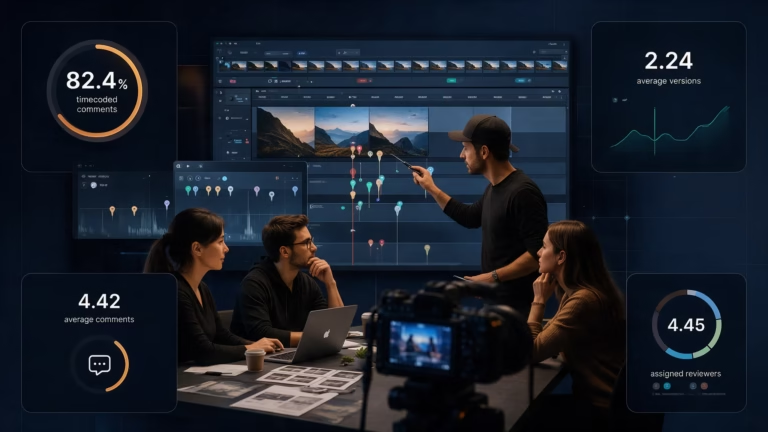
Frame-accurate commenting. Clients drop comments pinned to the exact frame or timestamp. No more “somewhere around the 0:30 mark” emails. Everyone sees the same frame and the same feedback at the same time.
Unlimited reviewers on every plan. This is the differentiator that matters most for agencies. You pay per creator, not per person who clicks a review link. A 5-person studio can share a cut with a 40-person client team without touching its plan pricing. Frame.io charges per reviewer seat. Ziflow charges per reviewer seat. Krock.io doesn’t.
Full production coverage. Most review tools handle one stage of the workflow. Krock.io covers the full pipeline: storyboard creation and animatic review at the pre-production stage, then frame-accurate video review, annotation, version management, and approval tracking through final delivery. One tool instead of four.
Integrations that matter. Adobe Creative Cloud, DaVinci Resolve, Final Cut Pro, and Slack. These are the tools video agencies already use. Krock.io fits into the existing workflow rather than replacing it.
Pricing. Krock.io Pro starts at $10/user/month. At 10 users, that’s $100/month versus Frame.io’s Team plan at $25/member (roughly $250/month for 10 seats) and Ziflow’s Standard plan at $199/month for 15 users. Reviewers are always free on Krock.io. See how the costs compare against the major alternatives.
Mini-scenario: Jamie runs a 6-person video agency in Austin. Her team was managing client feedback across email chains, Slack threads, and occasional WhatsApp voice notes from one particularly involved CMO. A 60-second brand video was on its 11th revision round, mostly because nobody could track which feedback had been addressed. After switching to Krock.io, the next project closed at three revision rounds. The CMO loved that she could record a video comment explaining her notes rather than typing them out.
Best for: Video production agencies, animation studios, advertising creative teams, motion graphics teams, agencies handling mixed media (video + image + audio + PDF in the same project).
Not the best fit for: Document-only agencies reviewing PDF proofs or print artwork. For those, look at Ziflow or GoProof.
Want to try it first? Krock.io’s free plan includes unlimited reviewers, 2 projects, and the full media review suite. No credit card required.
Teams evaluating Krock.io against other production tools — especially ftrack, which is common in VFX and post-production studios — can find a direct feature comparison at Krock.io vs. ftrack.
Ziflow, Best for Enterprise Document Proofing
Ziflow is the tool Krock.io is frequently compared against, and there’s a fair reason for that: it’s strong at document and creative asset review for larger organizations. Where Ziflow pulls ahead is in structured review workflows with multiple approval stages, custom automated routing, and audit trails that enterprise compliance teams care about.
What it lacks is a meaningful video-native experience. Ziflow handles video files, but it wasn’t built for frame-accurate production feedback the way Krock.io was. And the paid tiers cap the number of internal team seats included, which pushes agencies with larger teams into the Pro or Enterprise plan even though reviewers themselves stay free. For a direct comparison, see our Ziflow alternative breakdown.
Starting price: $199/month billed annually, for 15 team seats — reviewers are unlimited and free on every Ziflow tier.
Best for: Enterprise agencies with complex approval chains and document-heavy deliverables.
Frame.io, Best for Adobe-Native Video Teams
Frame.io is the incumbent in video review, now owned by Adobe and deeply integrated with Creative Cloud. If your entire post-production team lives in Premiere Pro and After Effects, Frame.io’s native integration is hard to beat from a workflow standpoint.
The problem is pricing for the internal team. Frame.io’s Team plan runs $25/member/month, so a 10-person production team lands around $250/month before add-ons. External clients can comment for free through share links, which softens the sting — but once an agency wants clients working inside the actual workspace instead of a share link, seats add up fast.
Agencies whose review needs lean more toward static design, PDFs, and image proofing rather than video should look at dedicated design review software options, which are built around pixel-accurate markup instead of frame-accurate video annotation.
Starting price: $15/user/month (creators only; reviewer seats are additional).
Best for: Adobe-dependent post-production teams where deep CC integration is the priority.
Best Design and Creative Software for Agencies

Every creative agency needs professional design tools. This category is less about finding the hidden gem and more about matching the right tool to your team’s actual workflow.
Figma, Best for UI/UX and Collaborative Design
Figma has become the default for digital-first agencies, and for good reason. Real-time collaboration, browser-based access, and a component system that scales across large design projects. Clients can review and leave comments without installing anything.
For agencies producing websites, apps, or digital campaigns, Figma is close to essential. Its free tier is genuinely useful for small teams. The paid plans add advanced features like Dev Mode, unlimited version history, and admin controls for larger orgs.
Starting price: $16/user/month (Professional). Free tier available.
Best for: Digital agencies, UI/UX studios, web design teams.
Adobe Creative Cloud for Teams, Best for Full-Service Agencies
If your agency spans print, video, motion, illustration, and web, Adobe Creative Cloud is the industry standard for a reason. Premiere Pro, After Effects, Illustrator, Photoshop, InDesign, and Audition cover every production format in one subscription. The Creative Cloud Libraries system keeps brand assets consistent across the whole team.
The cost is the main friction point. At $99.99/user/month per seat (teams plan), it’s one of the priciest line items in any agency stack. But for full-service creative operations, there’s no real alternative that covers the same surface area.
Starting price: $54/user/month (Teams).
Best for: Full-service agencies with mixed production across print, motion, digital, and audio.
Canva for Teams, Best for Lightweight Creative Needs
For content agencies, social media teams, or smaller operations that don’t need the full Adobe suite, Canva fills a real gap. The template system and ease of use mean non-designers on the team can produce on-brand work without creating rework for the design lead.
It’s not a replacement for professional design tools, but it’s not trying to be. If your deliverables are primarily social graphics, presentations, and marketing collateral, Canva can handle the majority of production with far less training overhead.
Starting price: $10/user/month (Teams).
Best for: Content agencies, marketing teams, smaller operations with non-designer staff.
Best Project Management Software for Creative Agencies
Generic project management tools were built for software teams. They track tickets, sprints, and bugs. Creative agencies have different needs: asset versioning, client-facing status, delivery milestones, and approval workflows that don’t fit neatly into a backlog. The tools below are the best options that understand creative work.
Mini-scenario: Marcus leads a 22-person integrated creative agency in Chicago. For two years, they ran all projects in Asana because the CEO had used it at a previous tech job. The problem: Asana has no concept of a creative brief, a revision round, or an asset version. Producers created elaborate workaround systems using custom fields and subtasks. When Marcus switched the team to monday.com with a template built for creative briefs and deliverables, the onboarding time for new project managers dropped from two weeks to three days.
monday.com, Best for Mid-Size Agencies
monday.com is the closest thing to a purpose-built creative agency PM tool without being niche. It’s flexible enough to handle production timelines, client milestones, and team capacity planning in one view. The visual board approach works well for producers and creative directors who think in timelines rather than ticket queues.
The workflow automations are strong: automatically move a task to “in review” when an asset is uploaded, notify a client when their feedback is needed, or ping the lead editor when a deadline is 48 hours out. For agencies managing 10+ active projects at once, that automation layer saves meaningful time.
Starting price: $12/user/month (Standard).
Best for: Mid-size agencies (10-50 people), multi-client production environments, teams that want visual PM over spreadsheet-style views.
Asana, Best for Process-Heavy Teams
Asana is stronger than monday.com for teams with highly structured, repeatable processes. If your agency runs the same project type repeatedly (weekly social content for 20 clients, say), Asana’s rules and templates can automate a significant portion of the setup overhead.
Where it lags behind monday.com is in visual flexibility and creative-specific workflow features. It’s a better fit for process-driven agencies than for production-heavy ones.
Starting price: $10.99/user/month (Premium).
Best for: Agencies with high-volume, repeatable project types.
ClickUp, Best for Budget-Conscious Agencies
ClickUp tries to do everything: project management, docs, time tracking, goals, and even a basic CRM layer. The ambition sometimes outpaces the polish, but for smaller agencies that can’t afford to pay for five separate tools, ClickUp’s breadth is a real advantage.
The free tier is unusually generous compared to competitors. For a freelancer or small studio, it can cover project management, basic documentation, and time tracking at no cost.
Starting price: $7/user/month (Unlimited). Free tier available.
Best for: Freelancers, small agencies, teams building their stack on a tight budget.
Linear, Best for Tech-Savvy and Fast-Moving Agencies
Linear has built a strong reputation in software development teams, but creative agencies with a technical edge are adopting it fast. The reason: it’s the fastest, cleanest project management interface available. No drag on load, no clutter, keyboard-first navigation that genuinely cuts the overhead of managing work.
Where Linear pulls ahead of Asana and monday.com is in speed and focus. Issues move quickly, cycles (Linear’s version of sprints) work well for agencies running on tight two-week content or campaign cadences, and the GitHub integration makes it a natural fit for agencies doing web or product work alongside creative production.
The tradeoff: Linear is less configurable than monday.com for visual production timelines, and the learning curve is steeper for non-technical producers. For agencies where the ops lead or project manager comes from a tech background, it’s an excellent choice. For traditional creative studios, monday.com remains more approachable.
Starting price: $10/user/month (Basic). Free tier available (up to 250 issues).
Best for: Tech-forward agencies, digital product studios, agencies running sprint-based content or campaign workflows, teams that value speed and keyboard-driven PM over visual customization.
Best Client Communication and Collaboration Tools
Client communication tools are the connective tissue of every agency. These aren’t where work happens, they’re where work gets explained, updated, and aligned.
Slack, Standard for Internal Comms
Slack is the default for internal team communication at most agencies over 5 people, and for good reason. Channel-based organization, threaded discussions, and an integration library that connects to every other tool in this list make it the most practical choice for day-to-day coordination.
For external client communication, Slack Connect works if the client is also a Slack user. If they’re not, expect to manage a separate email-based communication layer alongside.
Starting price: $8.75/user/month (Pro). Free tier available.
Best for: All team sizes for internal communication.
Loom, For Async Client Updates
Loom belongs in this section specifically for client-facing use: walking a client through a deliverable, explaining a design decision, or presenting a revised cut. A 3-minute Loom is often more effective than a 45-minute call.
For agencies, it’s a particularly useful tool during the review cycle. Recording a walkthrough of a new version gives clients context before they start leaving comments, which typically results in more focused, actionable feedback.
Starting price: $12.50/user/month (Business). Free tier available (limited).
Notion, For Shared Client-Facing Documentation
Notion works well for client portals, project wikis, and shared documentation. If your agency delivers ongoing retainer work, a shared Notion space gives clients a single place to find brand guidelines, project status, and historical work.
It’s less of a communication tool and more of a documentation hub, but that’s an underserved function in most agencies.
Starting price: $8/user/month (Plus). Free tier available.
Best Client Management and Reporting Software
The final category covers the relationship-management layer: tracking leads, managing client relationships, and reporting on results.
HubSpot CRM, Best for Growth-Focused Agencies
HubSpot’s free CRM is one of the most genuinely useful free tools in the entire agency stack. Contact management, deal pipeline, email tracking, and meeting scheduling are all included at $0. The paid tiers add marketing automation, sequences, and deeper analytics.
For agencies focused on business development alongside delivery, HubSpot brings BD and account management into one place without the learning curve or cost of Salesforce.
Starting price: $0 (CRM). Marketing Hub from $15/user/month.
Best for: Any agency that wants to professionalize its business development.
Agency Analytics, Best for Digital/SEO Agencies
Agency Analytics is built specifically for reporting to clients on digital marketing results: SEO rankings, Google Ads performance, social metrics, and web analytics in one automated dashboard. If you deliver ongoing digital marketing services, the time saved on client reporting alone justifies the cost.
Starting price: $59/client/month (Freelancer). Scales by number of clients.
Best for: SEO agencies, PPC agencies, digital marketing retainer services.
Attio, Best for Agencies That Want CRM Built for the AI Era
Most CRMs were designed before automation and AI became core to how agencies operate. Attio is different. It’s a next-generation CRM built around flexible data models, native AI features, and deep automation — so agencies can build client relationship workflows that match how they actually work, not how Salesforce expected them to work in 2005.
Where Attio stands out for creative agencies: it treats your contacts, companies, and deals as structured data you can query and act on, rather than a database you have to maintain manually. You can build automations that trigger on deal stage changes, auto-enrich client records from LinkedIn, and create custom pipelines for new business, project renewals, or partnership tracking without needing a developer.
The interface is clean and fast — closer to Notion than Salesforce in feel. For agencies that want the power of a proper CRM without the overhead of HubSpot’s sprawl or Salesforce’s complexity, Attio is the most compelling option in the market right now.
Starting price: Free tier available. Plus plan from $36/user/month.
Best for: Modern agencies with active business development, teams that want AI-assisted CRM workflows, agencies scaling from founder-led sales to a structured new business process.
How to Build Your Agency Software Stack by Size
No single stack works for every agency. Here’s a practical guide by team size.
Solo and Freelance (1-3 people)
Keep it minimal and free where possible. You can’t afford to spend $300/month on tools before you’ve paid yourself.
- Review/proofing: Krock.io free plan (2 projects, unlimited reviewers, no credit card)
- Design: Figma free tier
- PM: ClickUp free or Notion
- Comms: Slack free tier
- CRM: HubSpot free CRM
Monthly cost: $0-$20. Expand when you hit real pain points.
Small Agency (4-15 people)
At this size you need proper version control, client-facing professionalism, and basic automation. The review tool becomes essential because scattered email feedback is costing you real time.
- Review/proofing: Krock.io Pro ($10/user/mo, at 10 users, $100/mo total with unlimited reviewers)
- Design: Figma Professional ($16/user/mo)
- PM: monday.com Basic ($9/user/mo)
- Comms: Slack Pro ($8.75/user/mo)
- CRM: HubSpot free tier
Estimated monthly cost: ~$280-450 for a 10-person team. That’s well under $50/person.
Mid-Size Agency (16-50 people)
At this scale, integration between tools matters. Broken workflows become expensive. Invest in tools that connect to each other and reduce manual handoffs.
- Review/proofing: Krock.io Pro or Unlimited (fixed rate for 20+ users starts making sense)
- Design: Adobe Creative Cloud for Teams + Figma
- PM: monday.com or Asana with automation turned on
- Comms: Slack Pro with integrated Krock.io notifications
- CRM: HubSpot Starter or better
Focus: build automations that move projects through stages without manual status updates.
Enterprise Creative Team (50+ people)
At enterprise scale, the priority shifts to governance: who approves what, where work lives, how to maintain brand consistency across dozens of concurrent projects.
- Review/proofing: Krock.io Unlimited (flat rate, unlimited users) or Ziflow if document compliance is a priority
- Design: Adobe CC Teams + Figma Organization
- PM: monday.com Enterprise or ClickUp Business Plus
- Comms: Slack Business+
- CRM: HubSpot Professional or Salesforce
For project management for creative teams at enterprise scale, the right PM tool is the one your producers will actually use.
What to Look for When Choosing Creative Agency Software
Before you commit to any tool, run it against these five criteria.
Reviewer access model. If a tool charges per reviewer seat, your costs grow every time you add a new client or stakeholder. Tools like Krock.io charge per creator, not per reviewer. That’s the right model for agencies.
Integration with your native tools. An agency running Adobe CC wants review tools that work inside Premiere Pro. A team on DaVinci Resolve wants the same from their review software. Integrations that fit your existing workflow reduce friction. Integrations that require you to change your workflow usually get abandoned.
Client-facing UX. Your clients should be able to review work without creating an account, downloading software, or taking a tutorial. The easier it is for clients to use, the more likely they’ll actually use it instead of reverting to email.
Mobile accessibility. Clients review work on phones. Stakeholders watch cuts on iPads on planes. Any review tool that doesn’t have a solid mobile experience is going to result in “I’ll check when I’m back at my desk” and another day lost.
Scalability without seat surprises. The worst pricing models penalize you for growing. Before you commit to any tool, calculate the cost at 2x your current team size and 3x your current client roster.
Mini-scenario: Priya’s 8-person creative agency signed a new enterprise client whose internal approval chain included 14 stakeholders across three departments. With their previous review tool, adding 14 reviewers would have pushed the monthly bill up by $210. With Krock.io, she sent 14 reviewer links without touching the plan. The client’s legal team, marketing lead, and regional managers all left timestamped feedback on the same cut, and Priya’s editor resolved each comment as it was addressed.
The Stack Most Agencies Already Use (And Why It Has Gaps)
Walk into most creative agencies today and you’ll find some version of this creative agency software stack:
- Adobe CC for production
- Google Drive or Dropbox for file storage and “review”
- Email for client feedback
- Slack for internal communication
- Asana or monday.com for project management
- HubSpot or Pipedrive for CRM
It works, until it doesn’t. The gap is in the review layer. Google Drive gives you comment threads on documents. Dropbox gives you annotations on images. Neither was built for frame-accurate video review, version tracking across dozens of assets, or approval workflows with multiple stakeholder stages.
The fix is targeted: add a proper online proofing solution for creative teams without overhauling everything else. For most agencies, that’s the single change that has the biggest immediate effect on revision cycles and client satisfaction.
Conclusion
The best software stack for a creative agency isn’t the most feature-rich. It’s the one that covers each category well, connects where it needs to, and actually gets used by your team and your clients.
Start with your biggest pain point. For most creative agencies, that’s the review and approval process: scattered feedback, no version control, and revision rounds that never seem to end. Get that right first.
Then layer in the project management, communication, and CRM tools that fit your size and workflow. Build up gradually, and cut tools that your team isn’t using.
For the review and proofing layer: Krock.io’s free plan includes unlimited reviewers, full media review, and the storyboard tool with no credit card required. Start there and see if it fits before you commit.